Question & Answers
Welcome to our FAQ page. Here, you’ll find an overview of the most frequently asked questions about workplace safety and Boplan’s safety solutions. Can’t find your question here? Our experts are on hand to give you personalised advice.
Safety solutions
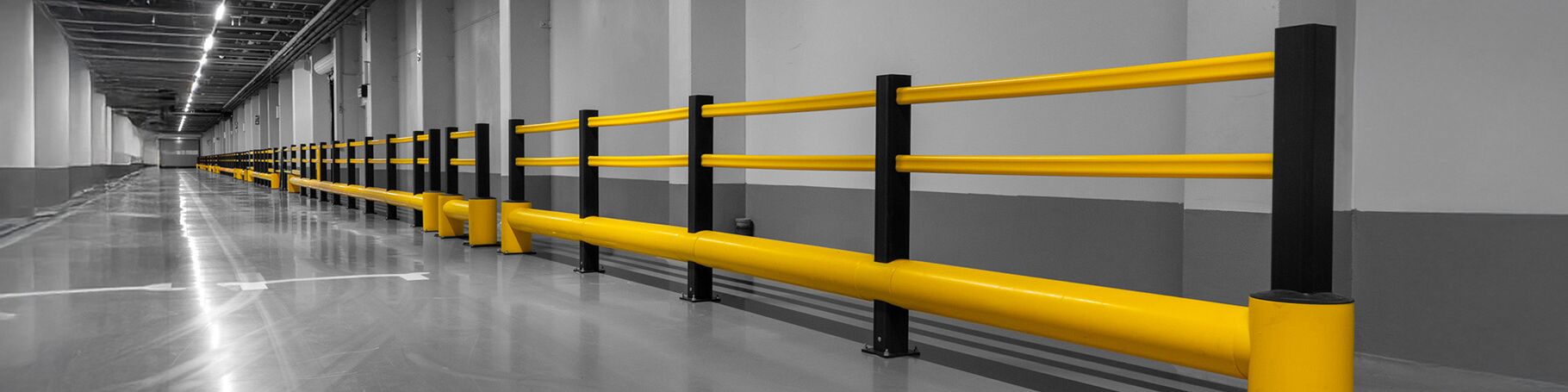
Safety solutions are essential for protecting workers, machinery and buildings. They limit the impact of accidents, reduce absenteeism and boost productivity. They also create a professional impression for visitors and customers. Discover Boplan’s polymer safety solutions and improve your workplace safety.
Safety solutions are used wherever people, vehicles and infrastructure come together: warehouses, production sites, cold storage facilities, airports, (petro-)chemical sites, car parks, logistics centres and other industrial environments. See all applications here.
In every warehouse, well-designed safety solutions are essential: from safety barriers and handrails to column protection and floor marking tape. This reduces the risk of forklift accidents and helps create clear, safe traffic flows. Find out which solutions are essential for keeping your warehouse safe.
Polymer safety solutions are modular protection systems made from high-quality polymer. They absorb impacts and spring back after a collision. That way, they protect pedestrians and limit damage to vehicles and infrastructure. Discover Boplan’s polymer safety solutions and improve your workplace safety.
Boplan® polymer safety solutions are made from high-quality, impact-resistant polymer that can absorb heavy impacts. Compared to steel and concrete, they are:
- Lighter and therefore easier to install
- More sustainable thanks to the material they are made from and their longer service life
- Low-maintenance, with no rust or painting required
- Weather- and chemical-resistant, ideal for indoor and outdoor use
- Thanks to their modular design, they suit any working environment and remain flexible as you expand.
Discover Boplan’s polymer safety solutions and improve your workplace safety.
Yes. With the ICE FLEX® range, Boplan® offers safety solutions that can withstand temperatures down to -30°C. These safety barriers, handrails, gates and handrails continue to function safely even in freezer environments. You can find an overview of safety solutions for freezer rooms here.
The purchase price of polymer safety solutions is higher than that of steel alternatives. But thanks to their durability, long service life and low maintenance costs, the Total Cost of Ownership (TCO) is significantly lower. In other words: They’re the most cost-effective choice in the long term. Want to know more about our safety solutions? Explore our safety barriers here.
Boplan® solutions reduce the risk of impacts involving infrastructure and buildings, falls from height, and collisions between vehicles and pedestrians. That way, they protect people from injury and help protect infrastructure and buildings from damage. See our safety solutions here.
Choosing safety solutions depends on several factors:
- What you want to protect (people, infrastructure, buildings, etc.)
- Traffic flows
- The environment and risk zones
- The vehicles operating there (forklifts, pallet trucks, stacker trucks)
Using a risk assessment and the Boplan Impact Calculator makes it easy to identify the right solution. Ask our safety experts for advice.
Yes. Thanks to their UV, weather and chemical resistance, Boplan® polymer solutions are also ideal for outdoor use, for example in car parks or loading and unloading areas. See our safety solutions here.
Maintenance is minimal. Boplan safety solutions don’t need painting. They’re also corrosion-resistant and easy to clean. Unlike steel, which often suffers from rust or requires repainting. See the other advantages of polymer over steel and concrete here.
Not every type of safety solution is legally required, but safety standards and labour laws do require protective measures. With Boplan® solutions, you can meet the strictest safety standards and take a proactive approach to safety. See our safety solutions here.
Thanks to their strong, flexible polymer construction, Boplan safety solutions last for many years. Even in the most demanding environments, such as freezer rooms or (petro-)chemical sites. That makes them both sustainable and cost-effective. After a severe impact, they can be repaired easily, without having to replace the entire safety solution. See the other advantages of polymer over steel and concrete here.
Safety barriers
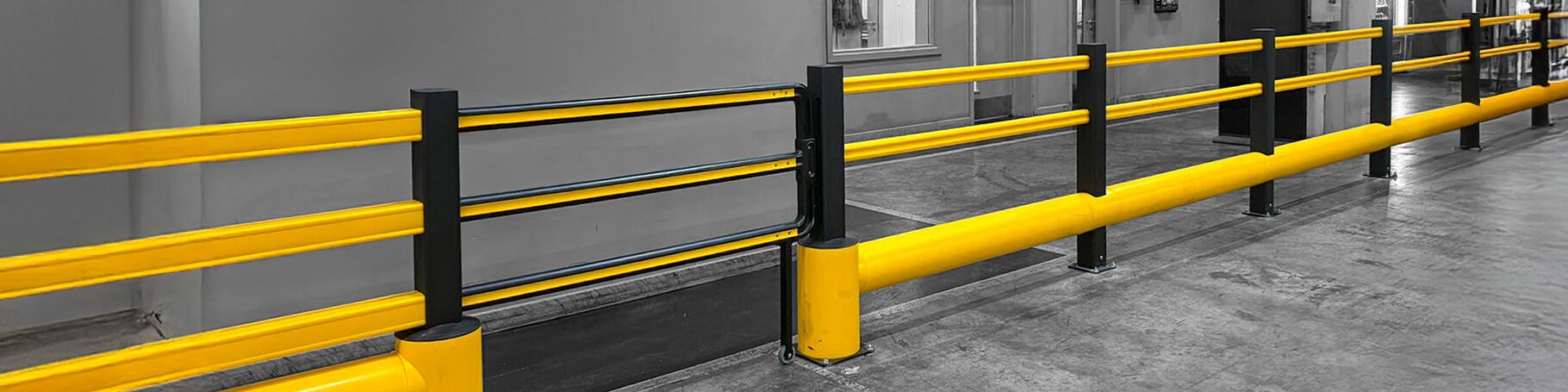
Safety barriers protect pedestrians, buildings, machinery and infrastructure from vehicle impacts. They ensure a safe separation of traffic flows between pedestrians and vehicles. Boplan® offers different types of safety barriers, often combined with other safety solutions such as handrails. Discover Boplan’s safety barriers here.
Choosing the right barrier depends on the application. Are you protecting people, racking, machinery, loading bays or critical infrastructure? Each situation calls for a different solution: from low barriers to robust column protection or barriers. Discover all Boplan safety barriers here.
Safety barriers come in different forms, depending on the risks at your workplace. The most common types are:
- Flexible modular safety barriers: suitable for intensive use in logistics, manufacturing and distribution centres.
- Bollards (protective posts): protect sensitive points such as loading bays, machinery, corners or access points.
- Handrails and safety gates: separate pedestrians and vehicles in busy traffic areas.
- Column and corner protection: prevent structural damage to load-bearing parts of buildings.
- Dock protection and loading dock protection: protect loading and unloading areas from impacts from lorries or forklifts.
- Low barriers and kick rails(plinth): ideal for guiding vehicles and demarcating pedestrian zones.
Safety barriers are most effective where incidents are most likely, across many industries. Think of:
- Crossings and walkways: where forklifts, pallet trucks and pedestrians cross, the risk of accidents is high. Safety barriers provide a safe separation of traffic flows here.
- Loading and unloading areas: lorries and forklifts often manoeuvre in confined spaces. Safety barriers help prevent damage to vehicles, loading docks and goods.
- Machines and production lines: expensive installations or vulnerable equipment are often the beating heart of your manufacturing. Protect them from unexpected impacts and costly repairs.
- Columns and building structures: a damaged column or support beam can jeopardise the stability of the entire building. Safety barriers prevent such critical risks.
- Cold and freezer rooms: Slippery floors increase the risk of slips and steering errors. Robust protection provides extra reassurance here.
- Parking areas and logistics hubs: where traffic converges, safety barriers reduce the risk of damage and accidents.
Safety barriers are crucial in any environment where internal transport, heavy traffic or complex logistics take place. Typical sectors include:
- Logistics & distribution centres: where forklifts, pallet trucks and lorries are constantly in motion.
- Manufacturing: protecting machinery, production lines and employees in dynamic environments.
- Chemical and petrochemical sites: increased risks from hazardous substances demand maximum safety.
- Food industry & cold storage: from busy warehouses to freezer rooms with slippery floors.
- Airports and parking facilities: high traffic volumes and critical infrastructure require reliable protection.
- Retail & e-commerce warehouses: high volumes and fast turnaround times bring additional risks.
- Pharmaceutical and medical sector: sensitive production and storage environments where safety cannot be compromised.
- Construction and heavy industry: protecting people and structures in harsh, challenging working environments.
Thanks to its wear-resistant, flexible polymer construction, Boplan® safety barriers are suitable for both indoor and outdoor environments, and continue to deliver long-lasting performance even in extreme temperatures or under intensive use.
Find out how Boplan® safety barriers are used in your sector.
The right choice depends on:
- What needs to be protected? (employees, racking, machinery, buildings, loading areas)
- Which vehicles operate on site? (forklifts, pallet trucks, reach trucks, lorries)
- Where are the risk zones? (walkways, crossings, gates, cold zones, outdoor areas)
- How great is the impact force? You can calculate this using our Boplan Impact Calculator. It takes into account the weight, speed and impact angle of vehicles.
Absolutely. Safety barriers are the foundation of a safe warehouse or industrial site, but deliver real added value when combined with other Boplan® solutions. This is how you build an integrated safety plan that protects people, vehicles and infrastructure:
- Bollards & protective posts: ideal for protecting critical zones, machinery, gates or loading points.
- Handrails create a clear separation between pedestrian zones and vehicle routes.
- Column and corner protection helps prevent structural damage to support columns, corners and building structures.
- Safety gates ensure safe passage and controlled access. For example, on stairs or in production zones.
- Kick rails protect walls and racking from low-level impacts and damage caused by pallet trucks.
- Loading dock protection: protects dock walls and loading bays against impacts from heavy vehicles.
- Moveable barriers: can be used flexibly to cordon off temporary or changing work zones safely.
- Floor marking tape visually guides traffic flows and improves orientation in busy or complex environments.
By combining these solutions intelligently, you create a comprehensive safety net that not only helps prevent accidents, but also avoids downtime, damage and costs.
Discover all Boplan® safety solutions and build your complete safety plan.
The benefits of safety barriers at a glance:
- Optimal protection for employees and visitors
- Helps prevent costly damage to buildings, machinery and vehicles
- Less downtime and production loss after incidents
- Meets the strictest safety standards
- Promotes a strong safety culture
- Strengthens your company’s safe, reliable image
Boplan® polymer safety barriers combine unique benefits:
- Impact-resistant: tested up to 50.10 kJ thanks to high-quality polymer.
- Flexible:: flexes on impact and helps prevent vehicle damage.
- Highly visible: supplied in high-visibility yellow as standard; other colours available.
- Modular: easy to expand and adaptable to any environment.
- Corrosion-resistant: resistant to chemicals, rust and bacteria.
- Versatile: suitable for use in sectors such as logistics, food, petrochemicals, aviation, manufacturing, etc.
With modular systems, installation is quick and straightforward. They can be installed with minimal downtime and easily expanded later. Find out more about the benefits of polymer safety barriers.
Flexible polymer barriers require little to no maintenance. Unlike steel, which can deform permanently or rust after an impact, polymer barriers return to their original shape and retain their appearance. You don’t need to paint them either. Find out more about the benefits of polymer safety barriers.
The level of protection depends on the impact resistance, measured in joules. Boplan safety barrier systems absorb the energy, take the hit and protect pedestrians, vehicles and infrastructure. After the impact, they return to their original shape. Boplan products therefore remain functional and retain their appearance, even after repeated impacts. Find out more about the benefits of polymer safety barriers.
The initial purchase price of polymer safety barriers can be higher than that of simple steel or concrete solutions. However, thanks to their impact absorption, longer service life, low maintenance costs and limited repair costs, the Total Cost of Ownership (TCO) is significantly lower. Find out more about the benefits of polymer safety barriers.
Choose solutions that meet the strictest EU standards and recognised certifications such as TÜV Nord or ISO. This guarantees reliability, quality and safety. Read more about polymer safety barriers.
Protective posts (bollards)
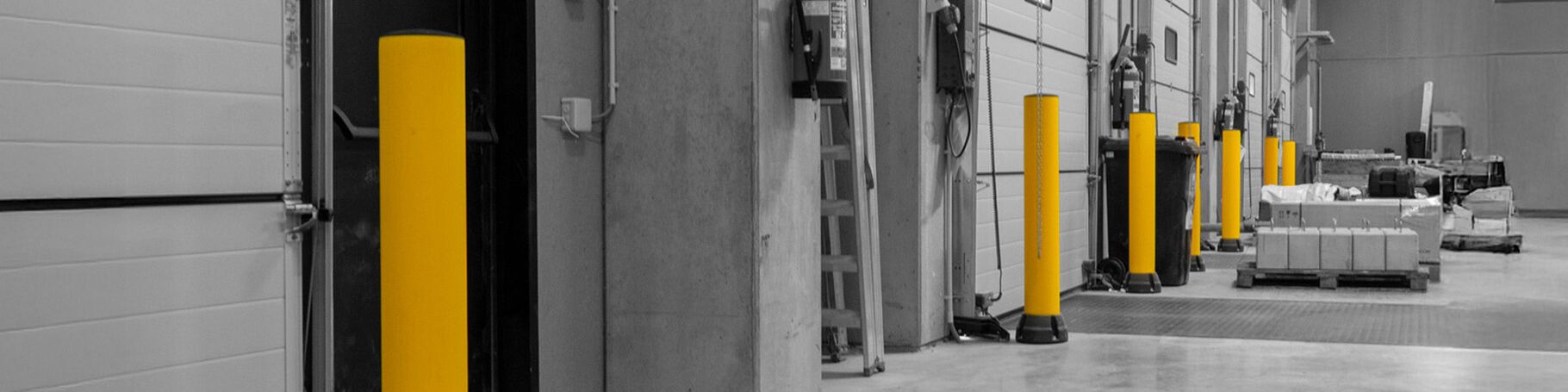
Protective posts (bollards) protect buildings, machinery and infrastructure from impacts. They also improve visibility and help control access to specific areas such as loading bays, access points or car parks. Boplan® offers bollards with different impact ratings, which can be combined perfectly with handrails or safety barriers. Read more about our protective posts (bollards) and improve safety at your workplace.
There are plenty of reasons to install bollards in your workplace. Protective posts (bollards) reduce the risk of accidents and damage in your working environment. They protect sensitive infrastructure (such as doors, columns, machinery and electrical cabinets), help prevent damage to buildings, and improve visibility. They can also be used to shield charging points and hazardous areas. Use a risk assessment and traffic plan to determine where bollards will be most effective. Read more about our protective posts (bollards) and improve safety at your workplace.
Protective posts, also known as bollards, are used in a wide range of locations to protect infrastructure, vehicles and people from impacts. They are suitable for both indoor and outdoor environments and are used in, for example:
- Warehouses and distribution centres: to protect racking, aisles and loading areas from forklifts and pallet trucks.
- Production sites: to protect machinery, production lines and critical equipment.
- Car parks and parking areas: to guide vehicles and protect charging points, walls or access points.
- Logistics centres: where freight traffic is intensive and the risk of damage is high.
- Airports and terminals: to separate passenger flows from service vehicles and protect sensitive infrastructure.
- Chemical and (petro-)chemical sites: where robust protection is needed around installations and tanks.
Protective posts (bollards) protect infrastructure and machinery. Thanks to their flexible polymer construction, Boplan® bollards are extremely strong, low-maintenance and 100% recyclable.
Read more about our protective posts (bollards) and improve safety at your workplace.
Yes. Boplan® protective posts (bollards) are specially designed for reliable performance even in the most hygiene-critical environments, such as the food industry, the pharmaceutical sector and cleanrooms.
- Hygienic Design: the smooth surface is easy to clean and helps prevent dirt build-up.
- Chemical resistance: resistant to detergents and aggressive substances commonly used in food and pharma environments.
- Corrosion-free & low maintenance: unlike steel, the polymer posts do not corrode, so there is no risk of rust.
- No bacterial growth: thanks to the non-porous structure, bacteria have nowhere to hide.
This makes Boplan® protective posts (bollards) the ideal choice for environments where both safety and hygiene are essential.
Read more about our protective posts (bollards) and improve safety at your workplace.
As standard, Boplan® protective posts (bollards) are supplied in safety yellow, the colour with the highest visibility in industrial and logistics environments. This provides a clear visual warning and improves workplace safety.
Protective posts (bollards) are also available in other colours on request. That way, they can match your company’s branding or specific site requirements such as colour-coding of certain zones.
In this way, you combine maximum safety with a consistent, professional look.
Read more about our protective posts (bollards) and improve safety at your workplace.
Yes. Boplan® polymer bollards are ideal for outdoor use. They are resistant to UV radiation, moisture, chemicals and extreme temperatures. As a result, they retain their functionality and appearance even in demanding outdoor environments. Explore our safety solutions for more information.
The right choice depends on the impact risks in your working environment. Use the Boplan Impact Calculator to quickly and accurately determine the most suitable type of bollard for your situation. It takes into account vehicle weight, speed and type.
Charging points are valuable and vulnerable installations. You can protect them by strategically placing hard-wearing protective posts (bollards) around charging points. This creates a physical barrier that:
- prevents impact damage during manoeuvres or steering errors.
- improves the safety of vehicles and drivers during charging.
- extends the service life of charging installations, reducing maintenance and replacement costs.
- gives employees, customers and visitors a professional, safe impression.
This keeps both the charging infrastructure and the surrounding area safely protected, without restricting access. More about protecting charging points with Boplan bollards.
Boplan® polymer bollards are flexible: they absorb the impact and return to their original shape. Metal or concrete bollards are rigid and can bend or break on impact. This can lead to higher repair or replacement costs. Polymer solutions are therefore more sustainable and more cost-effective in the long term. Want to know more? Read our blog post on polymer vs steel.
Boplan® bollards are 100% recyclable and have an exceptionally long service life. They support sustainable operations and can withstand intensive use in sectors such as logistics, food, petrochemicals and transport. Find out more on our sustainability page.
Flexible polymer posts return to their original shape automatically after an impact. Only in the event of severe damage will certain components need to be replaced. This minimises costs and downtime, unlike steel or concrete options that must be replaced in their entirety. Want to know more? Read our blog post on polymer vs steel.
The impact level depends on the following factors:
- Vehicle weight (forklifts, reach trucks, lorries)
- Their speed at impact
- The impact angle
Always choose protective posts (bollards) that meet recognised standards and certifications such as TÜV Nord and PAS 13. This guarantees reliability, safety and quality in the most demanding industrial environments. Find out everything about buying protective posts (bollards) here.
Boplan® protective posts (bollards) combine safety, sustainability and modularity:
- Easy installation, with no maintenance or painting required
- Resistant to chemicals, UV rays and corrosion
- Impact-resistant up to 24.1 kJ, TÜV NORD certified and tested to PAS 13
- Finger-safe, protected base plate fixings
- 100% recyclable and available in different colours and heights
- Made from Extrilene® polymer with exceptional shock absorption
- Patented technology
Read more about our protective posts (bollards) and improve safety at your workplace.
The strength of Boplan® bollards is the result of extensive R&D and testing. A unique combination of three characteristics ensures the bollards’ exceptional strength:
- Extrilene®: we developed this plastic specifically for even better impact resistance. A molecularly aligned material structure ensures unparalleled strength while retaining maximum flexibility.
- Multi-tube construction: greatly strengthens the entire structure, as the impact is distributed across a larger surface area.
- Optimised base plate: increases the post’s impact resistance.
Discover why Boplan protective posts (bollards) are the strongest on the market.
Delivery times vary depending on the type and quantity. Standard bollard models are typically available on short notice. For custom solutions, we will provide a personalised quote with a clear estimate. Contact us for your personalised quote and estimated delivery time.
Thanks to their modular design, you can install most Boplan® protective posts (bollards) yourself with ease. For more complex projects or demanding environments, we recommend professional installation. Refer to the product’s installation guide for details. Want to know more about our installation service? Click here.
Maintenance is minimal: polymer bollards are corrosion- and weather-resistant and don’t need painting. A regular visual inspection is enough to ensure safety. Read more about our protective posts (bollards) and improve safety at your workplace.

Height restrictors
Height restrictors prevent collisions with overhead obstacles. They consist of a horizontal beam supported by two protective posts (bollards). That way, they protect both infrastructure and vehicles such as forklifts or lorries. They are often installed at gates and entrances, or beneath canopies and bridges. Discover Boplan® polymer height restrictors here.
Height restrictors are useful in warehouses, factories, car parks, loading and unloading areas, distribution centres and other industrial environments. Wherever there is a risk of vehicles striking an overhead obstacle, height restrictors offer an efficient solution. Discover all applications for polymer height restrictors.
They protect gates, conveyors, pipes and other overhead structures from damage. This helps prevent costly repairs, downtime and risks to employees. They also improve safety by alerting drivers to the maximum clearance height. Discover Boplan® polymer height restrictors here.
Polymer height restrictors are flexible and give way on impact, limiting damage.
Metal alternatives are more rigid, deform permanently in a collision and typically need repair or replacement sooner.
Boplan® uses high-quality polymer that absorbs impacts, springs back and ensures long-lasting performance. Discover Boplan® polymer height restrictors here.
Yes, Boplan® polymer height restrictors are resistant to weather, UV radiation and extreme temperatures. They remain effective and low-maintenance even with long-term outdoor use. Discover Boplan® polymer height restrictors here.
The choice depends on:
- the height of the passageway or zone,
- the types of vehicles passing through (forklifts, lorries, reach trucks),
- the specific infrastructure that needs protecting.
Boplan® height restrictors are designed for quick, efficient installation. Thanks to their modular construction, the components are easily assembled on site without any need for major structural alterations. This means:
- Minimal downtime: installation can often be carried out while operations continue.
- Flexible installation: height restrictors can be freestanding or attached to existing structures.
- Custom lengths: they are made to measure to fit the width of passageways or zones perfectly.
- Quick anchoring: the use of robust fixing systems keeps them safe and stable, even after repeated impacts.
- Easy to expand: if the situation changes, the modules can be adapted or expanded easily.
In short: installing Boplan® height restrictors is quick, flexible and tailored to your site’s specific needs. Discover Boplan® polymer height restrictors here.
Maintenance is minimal. Polymer height restrictors don’t need painting, are rust-resistant and easy to clean. Discover Boplan® polymer height restrictors here.
In the event of an impact, the polymer flexes and absorbs the impact energy. This helps limit damage to vehicles and infrastructure. After the impact, the height restrictor returns to its original shape and remains functional. Discover Boplan® polymer height restrictors here.
Handrails
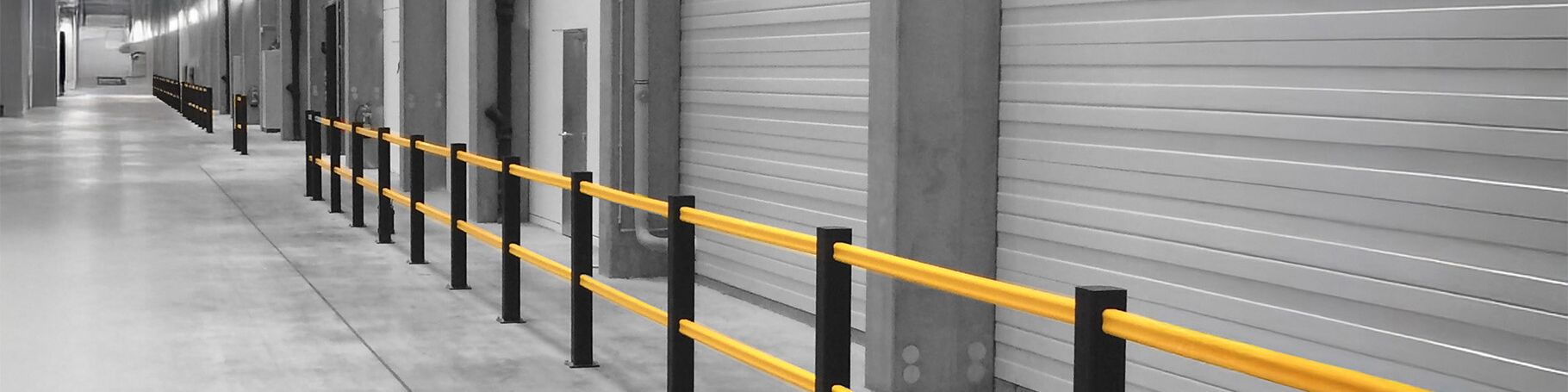
A handrail is a safety solution that guides pedestrians, restricts access or shields dangerous areas to keep people safe. Handrails can also be used to prevent falls from height. In this way, they contribute to the safety of people and goods in the workplace. You’ll often find handrails in warehouses, factories, distribution centres and other industrial environments. Find out more about handrails for industrial environments.
Handrails are essential because they:
- guide pedestrians and safely separate traffic flows,
- help prevent falls from platforms and walkways,
- shield dangerous machinery and equipment.
This helps reduce accidents and creates a safer working environment.
Find out more about handrails for industrial environments.
Key features include:
- Flexibility and shock absorption: polymer handrails flex on impact and return to their original shape.
- Sustainability: resistant to wear, UV radiation, chemicals and extreme temperatures.
- Visibility: supplied in high-visibility yellow as standard, with other colours available as an option.
- Modularity: easy to combine with other safety solutions.
Handrails can be used in all risk areas, including:
- along platforms, mezzanines and walkways to help prevent falls,
- along walkways to guide pedestrians (ideally with floor marking tape),
- around machinery to help prevent contact,
- at risk areas and loading zones to restrict access,
- in car parks to indicate safe pedestrian routes.
Yes. Boplan® polymer handrails are resistant to UV radiation, extreme temperatures, moisture and chemicals. That makes them ideal for outdoor locations such as car parks, loading and unloading areas, access roads and petrochemical sites. Unlike steel, they don’t rust or corrode, so they retain their long service life and low maintenance requirements even outdoors.
Find out more about Boplan handrails for outdoor use.
Boplan® polymer handrails:
- absorb impacts and return to their original shape,
- require little to no maintenance and are corrosion-resistant,
- are lighter and quicker to install,
- have a lower total cost of ownership (TCO).
Steel handrails are less flexible and require more maintenance after an impact or exposure to the elements. More about polymer handrails.
The Boplan® FLEX IMPACT® range offers flexible handrails for industrial and commercial environments. They are available in different versions:
- HD LIGHT for lighter applications
- HP PLUS for heavier-duty applications
All handrails are made from high-quality polymer that performs better than steel or concrete. They are also easily combined with other solutions such as safety gates, safety barriers and bollards. Discover the full range of handrails.
Thanks to their modular design, Boplan® handrails are quick and easy to install, with minimal disruption to operations. They can also be expanded or adapted later without any hassle. Discover the full range of handrails.
The price depends on the type of handrail and the application. Polymer handrails cost more upfront than steel, but are far more economical in the long run thanks to their durability, low maintenance costs and longer service life. Discover the full range of handrails.
Polymer handrails require virtually no maintenance. They don’t need painting, are rust-resistant and easy to clean. Discover the full range of handrails.
Yes. Boplan® handrails are part of a fully modular system and can be seamlessly combined with other safety solutions. Examples include safety gates (turnstiles, sliding gates and self-closing gates) for access control, but also safety barriers, bollards and floor marking tape.
This creates a comprehensive safety zone where pedestrians and vehicles remain safely separated and access is only possible at the correct points.
Thanks to the modular design, you can also easily adapt or expand your safety plan as your working environment evolves. Discover the full range of handrails.
Safety gates
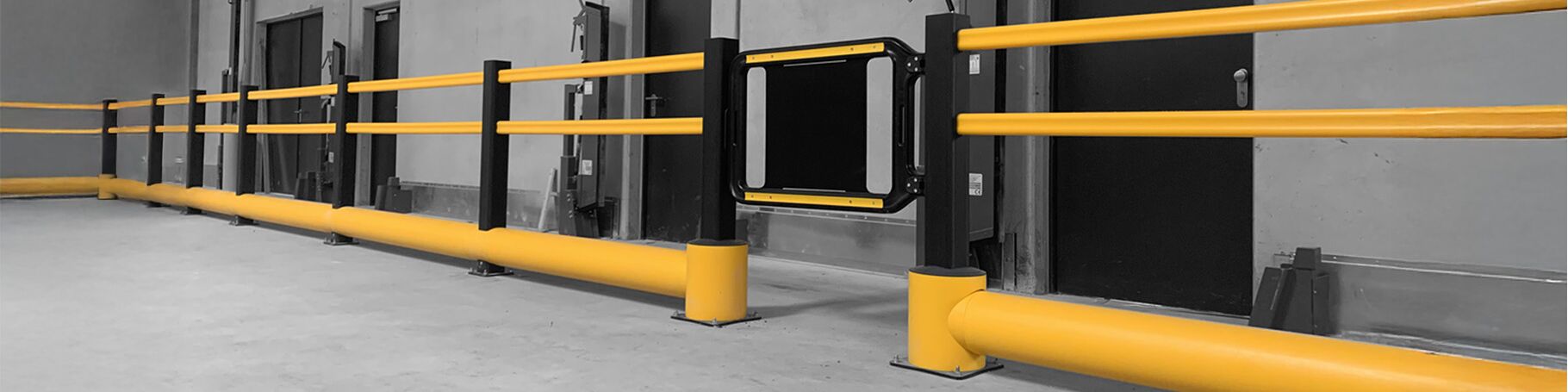
A safety gate is a safety solution that ensures the safety of employees and visitors by restricting or controlling access. These gates are used, for example, to guard machinery and prevent people from inadvertently entering dangerous or restricted areas. They significantly increase awareness and safety on any site. They are almost always combined with other safety solutions such as safety barriers, protective posts (bollards) and handrails. View all types of safety gates for industrial environments.
A safety gate is used, among other things, to:
- guard machines or production installations,
- help prevent falls from platforms, stairs and mezzanines,
- secure loading and unloading areas,
- limit access to high-risk areas.
Polymer safety gates are more flexible, rust-resistant and low-maintenance, while metal gates can feel sturdier but are more prone to corrosion and require regular maintenance. Read more about the differences between polymer and steel in this blog post.
Yes. Several Boplan® models are UV- and weather-resistant, making them suitable for both indoor and outdoor use, for example at loading docks, warehouse yards or parking areas. View all types of safety gates for industrial environments.
Boplan® safety gates comply with all relevant European standards and are certified by independent testing bodies (including TÜV NORD, ISO and PAS 13). This ensures quality, reliability and compliance with safety standards. View all types of safety gates for industrial environments.
Keep the following in mind:
- The application (machine protection, fall prevention, access control).
- The environment (indoors or outdoors).
- The passage width and height.
- The intensity of use.
- The required modularity and expandability.
- The required impact resistance.
Find the safety gate you’re looking for with the Boplan Impact Calculator.
Within the FLEX IMPACT® range, Boplan® offers a range of safety gates for different applications:
SWING GATE
SLIDING GATE
SINGLE AXES GATE
DOUBLE AXES GATE
DOCK GATE 250R
DOCK GATE 250F
DOCK GATE 250R AE
DROP GATE
BELT BARRIER
View all safety gates for industrial environments.
Boplan® safety gates come with an extended warranty period. The exact terms vary by product and are available in the product documentation or on request from our team. Contact us if you have any questions.
Thanks to their modular design, most safety gates are easy to install yourself. For complex environments or larger installations, professional installation is recommended. Watch the installation videos or contact us to use our installation teams.
Yes, thanks to their modular design, our safety gates are easily expanded, relocated or adapted to changing circumstances.
The service life of safety gates depends on the materials used and the level of maintenance. Polymer safety gates generally offer a longer service life and require minimal maintenance. Periodic cleaning is sufficient to keep them performing for years.
Inspect the damage immediately and contact us. With modular systems, damaged parts can be replaced quickly and easily.

Column protection
Column protection helps prevent costly, structural damage to columns, posts and pillars. These are often hit by forklifts or other moving equipment. Column protection preserves a building’s integrity and improves safety in industrial environments. Column protectors are available in various shapes and sizes for different column types and environments. Thanks to their energy absorption, Boplan column protectors reduce the force of vehicle impacts on columns. View all types of column protection for industrial environments.
Post and column protection is used wherever vehicles operate and there is a risk of collisions, such as:
- warehouses and distribution centres,
- car parks,
- cold and freezer storage,
- production halls,
- loading and unloading areas,
- petrochemical and chemical sites.
Learn more about the applications and benefits of post protection.
Boplan® column protectors combine safety with Sustainability and ease of use:
- Made from flexible polymer with high energy absorption.
- Available in high-visibility yellow for maximum visibility, or in other colours on request.
- Weather-resistant, UV-resistant and corrosion-free.
- Coloured through the material (no painting required).
- Low-maintenance, with a clean, modern design.
Column protectors are available in different shapes and sizes, ensuring a perfect fit for the columns in your environment. Depending on the application, you can choose from:
- Round column protectors – designed to protect posts and pipes.
- Square column protectors – ideal for load-bearing pillars and concrete columns.
- I-profile column protectors – specially developed for the commonly used steel H and I sections in industrial buildings.
There are also variants with different diameters and heights to protect against impact risks from forklifts, reach trucks and lorries.
Discover Boplan® column protectors.
Boplan® offers three types of column protection in the FLEX IMPACT® range:
- KP PROTECTOR - Round column protector for H-beam pillars and columns.
- CP UNIVERSAL - Modular protector suitable for columns of various shapes and sizes.
- SOFT COLUMN COVER - Shock-absorbing foam cover for light impacts.
That depends on:
- Column type (round, square, I-profile)
- Impact risk (light or heavy vehicles)
- Location (indoors or outdoors)
Use the Boplan Impact Calculator or request a risk analysis to choose the right column protector.
Absolutely. Boplan® polymer column protectors are UV-resistant, non-corrosive and resistant to extreme weather conditions such as rain, snow and temperature fluctuations. This makes them suitable for both indoor and outdoor applications, from warehouses and cold rooms to outdoor loading and unloading areas. Explore Boplan safety solutions for outdoor use.
Yes. Boplan® column protectors are modular and can be clipped around existing columns easily, without any structural work. This saves time and makes them ideal for retrofit projects. Thanks to the smart modular design, one person can carry out the installation. Discover our column protection.

Corner protection
Corner protection helps prevent damage to vulnerable corners in warehouses, production halls, airports or car parks. This safety solution protects both infrastructure and vehicles such as forklifts and pallet trucks from costly impact damage. More about corner protection.
There are several reasons to install corner protection at your workplace. The main ones are:
- Corner protection helps prevent injury by covering sharp edges and corners.
- Corner protection also prevents damage to equipment, machinery and infrastructure, as well as to the vehicle in question. This helps prevent costly repairs and downtime, which in turn extends the service life of machines and infrastructure and maintains productivity on the shop floor.
- Corner protection also serves as a visual warning. It increases safety awareness on the shop floor. Its presence alone is often enough to make people pay more attention and take the right precautions. This supports a strong workplace safety culture.
Within the FLEX IMPACT® range, Boplan® offers corner protectors in different sizes and diameters, suitable for a wide range of applications: Discover CP corner protection for vulnerable corners.
Yes. Thanks to their UV- and weather-resistant polymer, the corner protectors are also suitable for outdoor use, such as in loading and unloading areas or car parks. Discover CP corner protection for vulnerable corners.
Rack protection
Different types of pallet racking exist. Each one is suited to a specific warehouse layout or sector:
- Conventional pallet racking → the most common type: flexible and easy to adapt.
- Drive-in and drive-through racking → ideal for compact storage of large numbers of pallets.
- Pallet flow racking (flow racks) → pallets roll through automatically for efficient FIFO storage.
- Cantilever racking → suitable for long or bulky goods.
- Automated racking → integrated with warehouse robots or shuttles.
The right choice depends on your storage needs, stock rotation and available space.
Read more about choosing pallet racking.
Several factors come into play when choosing pallet racking:
- Type of goods (weight, size, stock rotation).
- The available space and height in your warehouse.
- Logistics processes: How often is a pallet moved? (FIFO/LIFO).
- Types of internal vehicles (forklifts, reach trucks, pallet trucks).
- Safety requirements: racking must meet the strictest standards and be complemented with rack protection to help prevent damage and collapse risk.
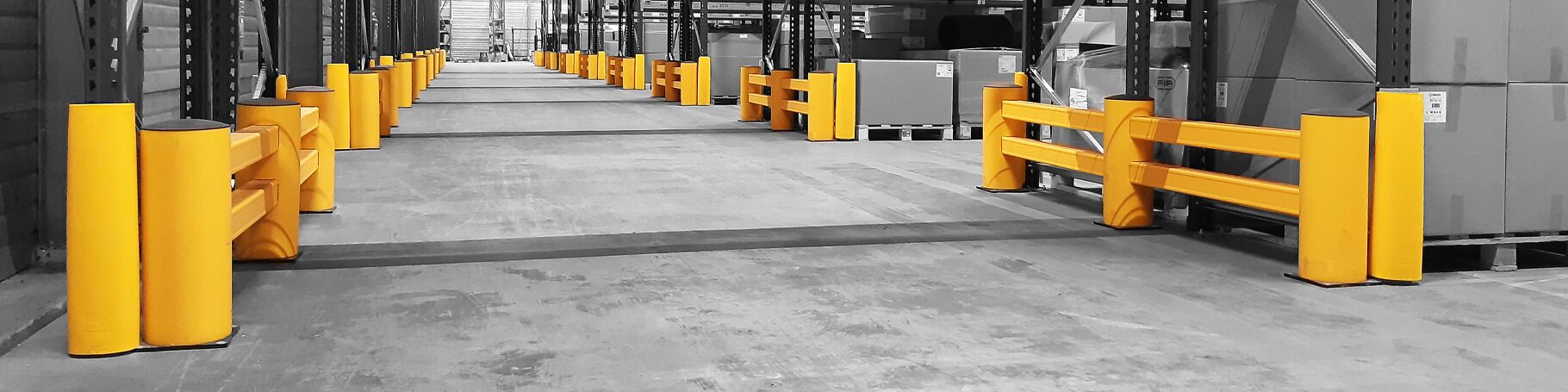
Rack protection helps prevent damage to pallet racking and racking structures in warehouses and distribution centres.
Forklifts, pallet trucks or reach trucks can often cause costly and dangerous impacts. Rack protectors absorb the impact, protecting infrastructure and helping ensure the safety of employees and goods. This helps keep your racking safe, stable and fit for long-term use. More about rack protection.
Workers are often under time pressure as they drive and manoeuvre forklifts, pallet trucks or stackers through tight spaces between racks. This can lead to collisions and damage. The consequences are serious: from minor damage to collapsed racking. With rack protection, you avoid costly repairs and improve the safety of employees and goods. Discover the rack protection options here.
Boplan® offers two innovative solutions:
- RACK END protects the vulnerable ends of stacking racks.
- RACKBULL® clips easily around uprights and fits any type of racking.
Both types are made from flexible, energy-absorbing material that springs back to its original shape after an impact. This keeps your racking protected and maintains its stability.
Discover Boplan rack protection options here.
- Universally applicable (RACKBULL® fits 90% of racking).
- Impact-absorbing: tested and certified for high impact values.
- Flexible and modular: easy to adapt or expand.
- Low maintenance: no rust, no painting.
- Highly visible: high-visibility colours provide maximum warning effect.
The choice depends on:
- The types of vehicles (forklifts, reach trucks, pallet trucks).
- The intensity of traffic in your warehouse.
- The highest-risk areas (racking, rack ends, passageways).
With the Boplan Impact Calculator, you can determine exactly what type of protection you need.
RACKBULL® is Boplan®’s patented universal rack protector, designed to fit 90% of standard racking. Thanks to the simple clip-on installation, you can protect uprights against impacts in seconds. It’s the most flexible solution on the market and TÜV NORD-tested for safety and reliability. More about the RACKBULL® rack protector.
Kick rails
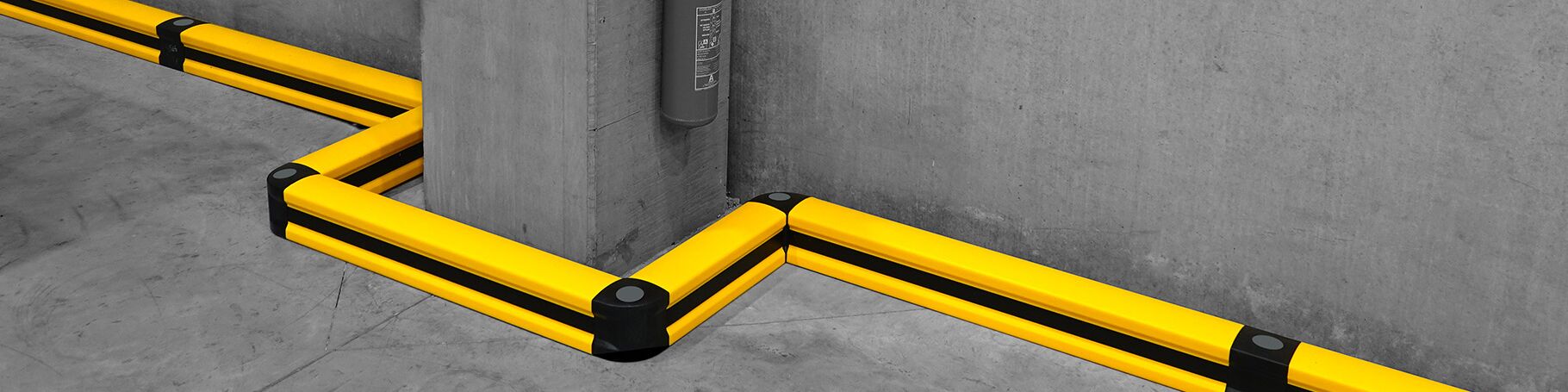
Kick rails are low, robust barrier solutions that provide protection at floor level. They help prevent forks on forklifts, pallet trucks or other vehicles from extending too far forward and damaging walls, machinery or racking. They add structure, create clear separations and improve safety in any industrial environment. Read more about kick rails.
Boplan®’s FLIP is an innovative kick rail that provides ground-level protection. Depending on the model, FLIP absorbs impacts from 2.6 kJ to 17 kJ. Key benefits:
- Flexible: absorbs impacts and remains functional.
- Highly visible: available in high-visibility colours, low-maintenance and does not need painting.
- Modular: easy to link and expand.
- Combinable: integrates seamlessly with other Boplan safety solutions.
Boplan’s FLIP safety solutions prevent damage to infrastructure, machinery, buildings or vehicles. Without these safety solutions, forklift forks can accidentally extend too far and collide with walls, machinery or other objects, leading to damage and repair costs. They provide wheel guidance, helping to prevent vehicles from rolling into pedestrian areas or other traffic zones and causing accidents.
Discover Boplan’s range of FLIP kick rails.
Wheel stops are safety solutions that prevent vehicles, trailers or other rolling material from moving when parked or loaded. They are also used to mark parking bays. This provides structure and a safe (working) environment. Learn more about wheel stops for industrial environments.
Boplan® offers different types of wheel stops and speed-reducing solutions, tailored to different applications:
- WS WHEELSTOP - ideal for parking environments, keeping even the heaviest vehicles safely in place.
- WS WHEELSTOP 105 - perfect for separating parking spaces; fitted with 8 reflectors for optimal visibility, even in the dark.
- WS WHEELSTOP 45 - a lower, slimmer version with a white reflective stripe.
- WHEEL SPEED CONTROL - a robust speed reducer that effectively forces drivers to slow down in areas where speed limits are critical. Think warehouses, car parks and loading areas.
Consider risk zones (walls, machine fronts, junctions), traffic intensity, vehicle types/speeds and the required absorption (kJ). The modular FLIP can be configured to measure and expanded later. Discover Boplan’s range of FLIP kick rails.
Yes. The polymer used to make FLIP is UV-resistant, weather-resistant and chemically resistant. In addition, FLIP retains its protective function in freezer/cold storage environments where traditional materials are quicker to degrade Discover Boplan’s range of FLIP kick rails.
While FLIP kick rails and low safety barriers both provide floor-level protection, they serve different purposes and have different impact resistance:
FLIP kick rails
Designed to protect floor level against low impacts, such as pallet truck wheels, roll containers or forklift forks. They guide vehicles and help prevent damage to walls, racking and infrastructure from minor impacts. Thanks to the modular system, they can be easily adapted to straight runs, corners or bends. Ideal in environments with heavy internal traffic close to infrastructure.
Low safety barriers
Built to withstand higher-impact loads, such as a forklift moving head-on or side-on. It often serves as a separation element between pedestrian zones and driving routes, or as robust protection for machines and installations. Thanks to their height and strength, they can withstand heavier impacts and help create clear traffic flows.
In an integrated traffic and safety plan, FLIP kick rails (plinths) and low safety barriers complement each other perfectly. More about kick rails.
The energy-absorbing polymer dampens the impact. After a major collision, inspect the area and replace only the affected part if needed. Discover Boplan’s range of FLIP kick rails.
Yes. FLIP integrates seamlessly with handrails, gates, safety barriers, bollards and floor marking tape for a complete, modular safety solution. Discover Boplan’s range of FLIP kick rails.
Moveable barriers
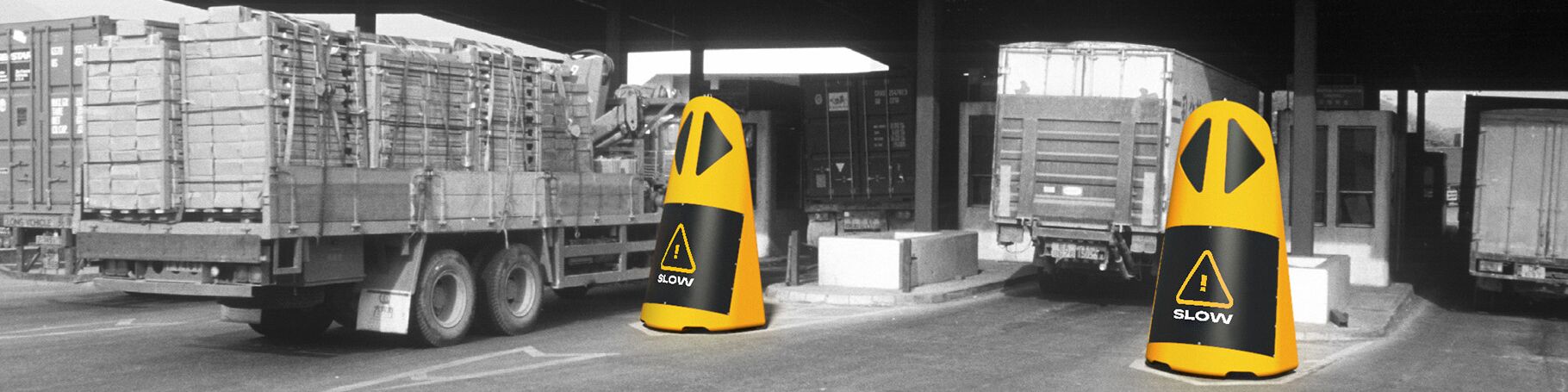
Moveable barriers are mobile safety solutions that allow you to quickly demarcate or cordon off areas temporarily. You can use them during maintenance work, temporary traffic diversions, events or high-risk situations in warehouses and factories. Their flexibility makes them ideal for unexpected situations where the workplace layout changes. Discover Boplan moveable barriers.
Safety cones are warning devices used to mark out areas and alert drivers. They are usually made from polymer or PVC and are available in high-visibility colours. Safety cones are used on construction sites, in warehouses, factories, airports and in car parks. They can also serve as temporary bollards at access points, doors or corners. Learn more about using Boplan moveable barriers.
Yes. Safety cones provide highly visible warnings and reduce the risk of collisions by alerting drivers. They can be used in warehouses, workshops, factories and on construction sites. There, they contribute to a clear and safe traffic layout. Learn more about using Boplan moveable barriers.
Yes. Plastic safety cones are UV- and weather-resistant and remain highly visible in a wide range of conditions. That makes them suitable for construction sites, car parks and outdoor logistics zones. Discover Boplan moveable barriers.
Always place cones where they are clearly visible and at drivers’ eye level, in combination with floor marking tape or temporary barriers. At gates, charging stations or during maintenance work, place them at the entrances or along the sides of the area so drivers will automatically adjust their speed. Discover Boplan moveable barriers.
The advantages of moveable barriers include:
- Easy to move and reuse.
- Cost-effective: ideal for temporary situations.
- Versatile: can be used in warehouses, at events, in maintenance areas or on roads.
- Quick to deploy: no complex installation required.
Protective bumpers
TEDDY PRO protective bumpers help prevent injuries and damage to infrastructure or machinery from minor impacts. They are ideal for corners and edges of racking, walls, columns or stair handrails. Thanks to the strong adhesive strip, they stick to almost any flat surface. For damp, oily or uneven surfaces, it’s best to use TEDDY PRO SSB profiles with a stainless steel base. Discover TEDDY PRO protective bumpers.
Boplan® TEDDY PRO protective bumpers combine safety with ease of use:
- Alternating yellow and black stripes warn passers-by of danger
- Flexible profile, suitable for use on curved surfaces as well
- Tear-resistant layer, suitable for use at temperatures from -40°C to +100°C
- Permanent solvent-free adhesive, suitable for most surfaces
- Silicone-free paper liner, easy to apply smoothly
They are suitable for warehouses, production halls, airports, car parks and public buildings. They are ideal wherever people could come into contact with sharp edges or infrastructure. Discover Boplan’s range of protective bumpers.
Yes. Thanks to the self-adhesive strip, they can be fitted without tools or screws. They can also be applied to curved surfaces, making them especially versatile. Discover Boplan’s range of protective bumpers.
Boplan®’s WALLY PRO protects manual call points against accidental activation. The durable elastomer absorbs knocks and helps prevent the call point from being pressed accidentally. This helps avoid unnecessary alarm activations and ensures reliability. Discover WALLY PRO manual call point protection here.
Floor marking tape
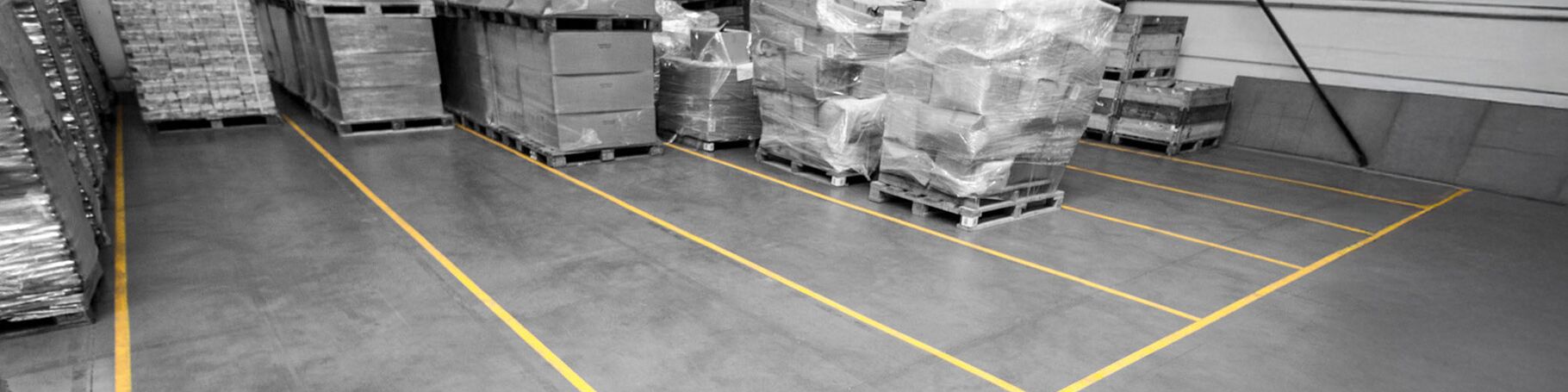
Floor marking tape is a safety solution used to mark out work areas, pedestrian routes and traffic flows. It improves visibility and increases safety awareness in the workplace.
There are different ways to apply floor marking tape. Think paint, low-cost tape or professional marking tape. Traditional solutions such as paint wear out quickly, require a lot of maintenance and can cause downtime when they need reapplying. Boplan® offers high-quality floor marking tape with the LINE PLAN range. Discover Boplan floor marking tape.
Floor marking tape offers many benefits for any industrial environment:
- Increases safety through clear signage
- Creates structure and order in the workplace
- Reduces the risk of collisions and accidents
- Supports efficient vehicle and pedestrian traffic flow
- Supports rapid evacuation in emergency situations
- Increases employees’ safety awareness
Physical protection is also essential. Discover all the benefits of floor marking tape.
Use a risk analysis and traffic plan to determine where floor marking is required. Overview of areas where signage is required:
- Roadways and walkways: to clearly indicate lanes and directions to drivers, to avoid collisions with other vehicles, machinery, or people.
- Hazardous areas where access is restricted. In such cases, entrances should be marked with floor tape.
- Car parks are also high-risk areas where collisions often occur. That’s why it’s recommended to mark out parking bays,
- Parking spaces: to clearly delineate parking areas and prevent collisions between parking vehicles. Differentiate between employee and visitor parking spaces,
- Loading points: to show where loading areas are and where pedestrian access is required.
The colour depends on the risks and applications:
- Red: prohibition, evacuation zones, defective goods
- Yellow: danger, traffic routes, work zones
- Green: directional indicators, emergency exits
- Blue: procedures, storage zones
- Orange: chemical storage
- Black and white: clear zones
- Red and white: areas with a risk of injury
With its unrivalled resistance to all types of friction, Boplan floor marking tape outperforms other floor marking tapes on the market. The marking tape has bevelled edges. This makes it stronger than other products and extremely suitable for high-traffic areas. The floor marking tape is also easy to apply yourself. The strong, self-adhesive backing stays firmly in place on a variety of surfaces, including concrete floors, walkways, corridors, traffic areas, etc. Read more about Boplan floor marking tape here.
Boplan® offers different types of floor marking tape within the LINE PLAN range: lines, pictograms and marking tape in various colours and applications. They improve safety and visibility in any workplace. Discover Boplan’s range of floor marking tape.
Temporary floor marking tape is used for short projects, events or temporary changes on the shop floor (e.g. warehouse works or temporary storage zones). This is often paint or low-cost tape that wears quickly and is easy to remove.
Permanent floor marking tape, on the other hand, is designed for intensive, long-term use. Think high-quality marking tape that can withstand heavy loads, forklift traffic and cleaning. It requires less maintenance and is far more durable.
With the LINE PLAN range, you choose durable, permanent floor marking tape that stands out from traditional paint or standard tape. Find out more about Boplan floor marking tape.
Service life depends on the type of floor marking tape, the environment and the load (e.g. forklift traffic).
Maintenance
Regular cleaning using standard methods prevents dirt or oil from reducing visibility.
Avoid harsh solvents that can damage the tape.
Check the edges of the tape regularly and replace damaged sections if needed.
Service life:
Paint or low-cost tape wears quickly and often lasts only a few months.
Professional floor marking tape such as Boplan® LINE PLAN lasts for years, even in demanding industrial use.
Thanks to the strong adhesion and wear resistance of Boplan® tape, markings remain visible and reliable for a long time, significantly reducing the total cost of ownership (TCO). More about floor marking tape.
A dock bumper is a safety solution that protects loading bay walls from damage caused by vehicles during loading and unloading. It is mounted to the loading bay wall and acts as a cushion or barrier between the vehicle and the dock. View this product.
General questions about Boplan
The joule is the international unit of energy. It indicates how much energy is needed to do work, or how much energy is released on impact. At Boplan®, we express the impact resistance of our safety products in joules. This makes the forces our solutions absorb clear and comparable. Find out more.
By expressing impact in joules, we make safety tangible and measurable. This makes it easy for companies to compare products and choose the right solution for the energy of potential collisions in their environment.
The impact absorption value varies depending on the impact angle. We measured the impact values for our products at different angles: 45° and 90°.
Read more about Boplan’s impact absorption ratings.
When a forklift hits an obstacle, it transfers a certain amount of energy to that obstacle. To stop the forklift, the obstacle has to exert a force over a certain distance. For a very rigid obstacle, such as a steel or concrete pole, this force will be enormous and stop the forklift truck over a very short distance. As a result, the enormous force damages both the forklift and the obstacle. With a more flexible obstacle, the force is reduced and the distance over which the forklift truck will stop is greater. We will illustrate this using an example.
Extrilene® is an exclusive, high-tech polymer developed by Boplan itself. It combines exceptional impact resistance with flexibility, recyclability and a long service life. The material is lightweight, modular, low-maintenance and meets the standards of the most demanding industries. Find out more about Extrilene®.
Extrilene® is a high-tech flexible polymer. Extrilene® is valued not only for its high impact resistance, but also for its excellent recycling properties and suitability for sectors with the strictest hygiene requirements. Thanks to a unique “slide-over” tube system, Boplan’s Extrilene® delivers the strongest impact-resistant safety barriers currently available on the market. Other features include:
- Absorbs extreme impacts
- Corrosion-resistant and low-maintenance
- Modular and lightweight
- Easy to install and expand
- Brightly coloured throughout
Extrilene® retains its properties for years, even in demanding environments where it is exposed to heavy impacts, chemicals, humidity or temperature fluctuations. The material does not tear or permanently deform, and remains functional after repeated impacts. Find out more about sustainability here.
We don’t believe in theoretical claims, but in proven results. That’s why we put our products through extensive crash tests with realistic vehicles and speeds. This ensures that our impact ratings are reliable and safety is genuinely guaranteed in real-world conditions. Read more about our testing here.
The Boplan Impact Calculator is an online tool that helps you quickly calculate which safety solution you need. Based on the vehicle’s weight, speed and impact angle, the tool calculates how much energy will be released by a collision and which products are capable of absorbing this safely. Discover the Boplan Impact Calculator here.
You enter three parameters: the vehicle’s weight, speed and angle of impact. The calculator immediately recommends the right safety solution. You can find this tool on our product detail pages or on this page.
Virtual simulations allow us to predict how a product will respond to impact at an earlier stage. They speed up development, save materials and reduce the number of physical crash tests without compromising reliability. More about our virtual simulations.
Physical crash tests remain essential as a final verification step, for example for certification. They confirm the accuracy of the virtual simulations and help ensure the end product is reliable. More about the innovation process.
- Faster Time-to-Market
- Robust products with maximum reliability
- More efficient use of materials (fit-for-purpose designs)
- Better alignment with production processes
- Targeted prototyping: only the necessary parts are physically tested
Simulations are at the core of the innovation cycle. Material properties from lab tests provide the input for simulations, leading to optimised designs. These designs are validated with a single physical test, after which the test data feeds back into further simulations, enabling continuous improvement. More about the innovation process.
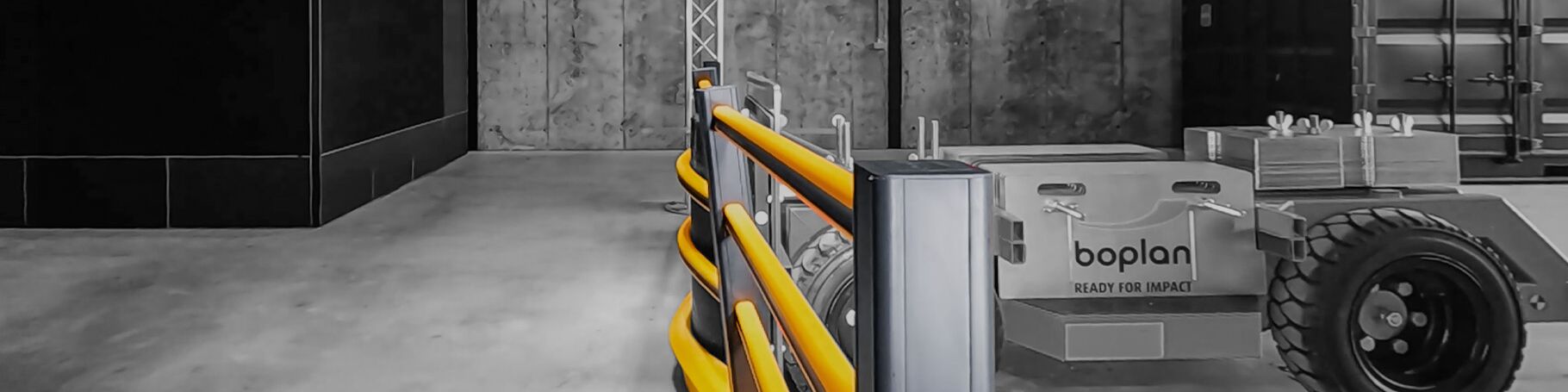
Every new safety solution is tested in the Indoor Test Lab. There, we simulate collisions using “The Beast”, a test truck with an adjustable weight (1,300–4,300 kg) and speeds of 2–16 km/h. Testing is carried out under the supervision of external partners such as TÜV Nord, with advanced data analysis via lasers, cameras and onboard computers. Our products are also independently tested on site by external partners. More about our testing facilities and procedures.
CID® detects critical impacts involving Boplan kick rails. When a severe impact occurs, red indicators become visible. This provides an immediate visual warning that inspection or replacement is required. This helps you maintain the safety and reliability of your installation. Read more about CID® here.
General questions about workplace safety
Workplace safety includes all safety measures, rules and regulations set by the government. We would also like to emphasise the importance of employee participation. The purpose of safety measures is to create a safer workplace. Their aim is to avoid accidents and provide protection against accidents. So, they are for both prevention and protection. They help to ensure a safe working environment for people, vehicles, infrastructure, machinery and buildings. Read all about workplace safety.
The employer is legally obliged to ensure a safe working environment. Employees, in turn, are responsible for following safety rules strictly. Safety is therefore a shared responsibility. Find out more about responsibilities for workplace safety here.
Risks vary by sector, but common hazards include: forklift traffic, falls, slip hazards, falling objects, poorly organised loading and unloading areas, or insufficient signage. What safety measures can you take?
- Perform a risk assessment
- Establish a traffic plan
- Train and educate
- Provide clear pictograms and use floor marking tape
- Use personal protective equipment (PPE)
- Install collective protective equipment such as plastic safety barriers
Start by analysing hazards, then assess likelihood and impact, and then determine corrective actions. You can use participatory (What-If, fishbone diagram) and quantitative methods (Kinney) to help structure and map the risks. More about carrying out a risk assessment.
After completing your risk assessment, the next logical step is to create a traffic plan. This is where you map the traffic flows in your workplace and find out where the bottlenecks are. Want to know more? Read our tips on how to create a traffic plan.
A traffic plan maps pedestrian and vehicle flows. You can physically separate these flows with safety barriers, fences, bollards and floor marking tape, using colour standards such as red for restricted zones, yellow for traffic, etc. Read our tips for creating a traffic plan here.
To create an effective traffic plan for safe internal transport, follow these four steps:
Create structure using signage
Start by applying floor marking tape. This helps you indicate clear walking and driving zones, define traffic routes for pedestrians and forklift drivers, and encourage safe distances. Divide the work area into zones such as work, storage and parking areas.
Colour coding for clarity
Use standardised colours to visually distinguish zones:
- Red: restricted zones
- White: storage zones
- Yellow: lanes and parking spaces
- Green: clear zones
- Blue: pedestrian zones
In addition to floor marking tape, you can use ISO 3864 pictograms: yellow/black for warnings, blue/white for mandatory actions, green/white for first aid and red for prohibitions or emergency equipment.
Set rules and internal instructions
Set clear traffic rules and communicate them to your team. Examples include right-of-way rules, signage, line marking and colour coding. This provides clarity and prevents confusion on the shop floor.
Implement and embed the plan
Roll out the traffic plan with employees and, where relevant, external stakeholders. Build buy-in by explaining and clearly communicating your arrangements.
More information on creating a traffic plan can be found here.
The 5S method (Sort, Set in order, Shine, Standardise, Sustain) helps create order in the workplace, reduce risks and increase productivity. More about 5S.
- Improved working conditions
- Better team cohesion
- Reduced risk of falls and trips
- Time savings and higher productivity
By evaluating the following step by step, for each zone: what is needed, how will I organise it, how will I maintain it, how do I establish standards and how can I sustain them using audits. More about 5S.
There are several steps companies can take to improve workplace safety and reduce work-related accidents:
Carry out a risk assessment
Map hazards and determine where preventive and protective measures are needed. This forms the basis for any safety policy.
Draw up a traffic plan
Map traffic flows and avoid conflicts between pedestrians and vehicles. This plan leads to recommendations for physical protection such as safety barriers.
Train staff
Ensure that all employees, both experienced staff and new colleagues, know and follow the safety rules through training sessions, toolbox talks or presentations.
Use pictograms and floor marking tape
Signage makes risks more visible and helps with the safe layout of zones. Think clear walkways, lanes and hazard zones.
Provide personal protective equipment (PPE)
Protect workers during high-risk tasks with helmets, harnesses, gloves, safety glasses and safety shoes.
Install collective protective equipment
Plastic safety barriers, handrails and kick rails not only protect employees, but also vehicles, infrastructure and buildings. They also increase safety awareness through their visibility.
You can find more information about the safety measures you can take here.
A loading dock is an essential part of any warehouse, distribution centre or industrial facility where goods are loaded and unloaded. A well-designed loading dock increases the efficiency, safety and throughput of goods flows. A poorly designed loading dock leads to delays, damage to goods and vehicles, and even accidents. That’s why it’s crucial to choose the right facilities and layout, tailored to the specific needs of your business.
The following collective protective equipment is required for fire protection:
- Fire-resistant compartments and doors.
- Clearly mark emergency exits and escape routes.
- Protect machines and installations with safety barriers.
- Signage and emergency lighting.
You can find out more about collective protective equipment for fire protection here.
- Separate pedestrians from vehicles with fences and markings.
- Install safety barriers around critical areas.
- Provide training and awareness.
You can find more tips on how to reduce forklift accidents here.
- Dirty, damp or slippery floors.
- Lack of anti-slip strips or handrails.
- Poor lighting or loose cables.
- Unsafe steps and poor maintenance.
- Human errors due to time pressure, stress or fatigue.
More information on how to prevent falls at work can be found here.
Falls and slips may seem harmless, but they can have major consequences. While you may be back on your feet again in no time to continue with your work, you may nevertheless have suffered a muscle tear – or worse, fractured a bone.
These types of injury are not only inconvenient in the short term, but often cause long-term problems. This can mean you are unable to work for a long time. It cannot be ruled out that the physical symptoms may not disappear completely. They also have extensive organisational and financial implications. It disrupts the smooth running of the business and generates unexpected costs.
The consequences are clearly significant, for both the employer and the employee. More information on how to prevent falls at work can be found here.
A company is responsible for creating a safe work environment. This can be accomplished through various preventive measures.
- Train staff
- Personal protective equipment
- Collective protective equipment
More information on how to prevent falls at work can be found here.
The risk zones where accidents are more likely to occur are:
- Aisles and racking: narrow aisles between high stacks can lead to collisions or falling goods
- Mezzanines or mezzanine floors: overloading, unstable stacks and fall hazards are major risks
- Walkways: personnel routes above forklift zones without suitable handrail protection are dangerous
- Loading docks and loading bays: heavy traffic from lorries, forklifts and pedestrians makes collisions likely
- Machinery areas: without physical barriers, pedestrians risk injury or collisions with machinery
- Platform edges: forklifts or goods can fall from platforms if they are not adequately cordoned off
- Forklift parking zones: unintended movements can cause damage or injury in tight parking areas
More information about risk zones and how to protect them can be found here.
- Incorrectly stacking goods
- Damaged or overloaded racking
- Careless use of forklifts
- Missing or insufficient load securing
Collective protective equipment: use guardrails, handrails with kick rails, safety gates such as the DOUBLE AXES GATE, and floor marking tape.
Personal protective equipment: PPE such as harnesses, lanyards, anchors, helmets and gloves. Extra: install fall arrest systems with nets, rail systems or fall-arrest solutions.
Always combine collective and personal protective equipment for greater safety. More information about safety measures to prevent falls from height.
A solution for every situation
Choose Boplan for your safety infrastructure needs
Our safety solutions are thoroughly tested, strong, innovative and modular. With low maintenance requirements and extensive testing, we provide reliable, durable protection solutions that exceed the current industry standards. Invest in our solutions for world-class safety and complete peace of mind.
Do you have a question that is not answered here?
Our experts are ready to give you personalised advice.