From crash test to virtual simulation: how simulations accelerate product development at Boplan
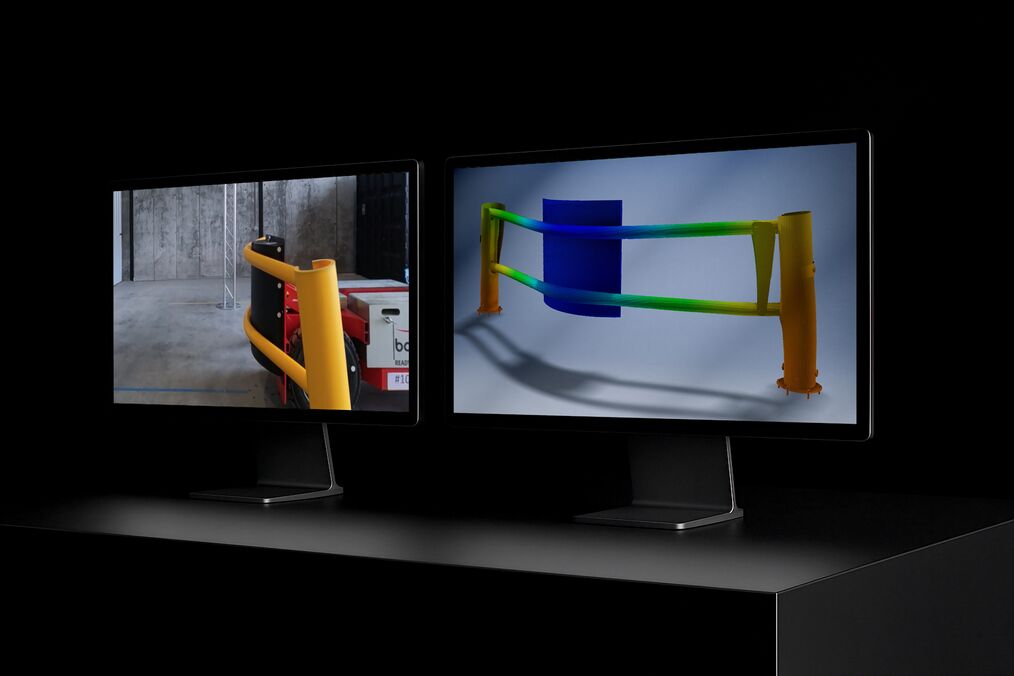
The days of relying solely on physical crash tests to evaluate our products are long behind us. Crash tests require extensive preparation and consume valuable materials. This makes them a costly affair. Thanks to advances in simulation technology, we can now perform virtual tests and optimise products at a much earlier stage. This approach makes the development process not only faster and more efficient but also more sustainable.
At Boplan, we still conduct physical tests—primarily as a final validation of the virtual simulations. This is especially important for certification purposes. However, where we once had to build and test multiple prototypes, a single physical test is now often sufficient. Virtual simulations have become the backbone of a modern, well-considered, data-driven product development strategy.
The role of simulations in the development process
Simulations are a vital part of our product development process. They allow us to predict how a product will respond to impact—long before a physical prototype is built. These virtual tests are not a replacement for the physical crash tests carried out in our in-house test facility. Rather, they serve as essential preparation. They enable us to develop faster, with greater focus and insight.
By using advanced computer models, we can accurately estimate the forces a safety solution will be subjected to during a collision with a vehicle. We don’t just analyse the effect of the impact; we also assess how all parts of the system — from the profiles to the base plates and attachment points — interact with each another. This gives us an in-depth understanding of how our materials and systems behave under pressure.
This knowledge allows us to design each component with precisely the right dimensions and shape— Fit-for-purpose product development. No over-engineering—just the certainty that the system will perform as intended. This approach ties in perfectly with our strategy of expressing product performance in kilojoules. Thanks to simulations, we can determine exactly how much impact energy a system can absorb—and how to achieve that performance.
5 benefits of simulations
1. Faster time-to-market
Simulations allow us to design faster and more efficiently. We test virtually, analyse and optimise—before the first physical prototype even exists. This significantly accelerates development and reduces time-to-market.
2. Absolute reliability of the end product
By simulating a wide range of scenarios, we gain deep insights into the performance of our products. This enables us to make targeted improvements and optimisations— Resulting in more robust and reliable safety solutions.
3. Smarter use of materials and optimisation
Simulations allow us to design each component to be truly fit for purpose. For example, we optimise wall thicknesses to achieve maximum impact resistance using the minimum amount of material. This approach reduces the use of raw materials and production costs—without compromising on safety.
4. Considering manufacturing requirements
We factor in not just structural strength but also the practical requirements of the production process— such as profile extrusion and part processing speeds.
5. Better prototyping preparation
Simulations help us prioritise our prototyping process. They indicate which components or moulds we need to develop and in what configuration— saving both time and resources.
Advanced simulations with Finite Element Analysis (FEA)
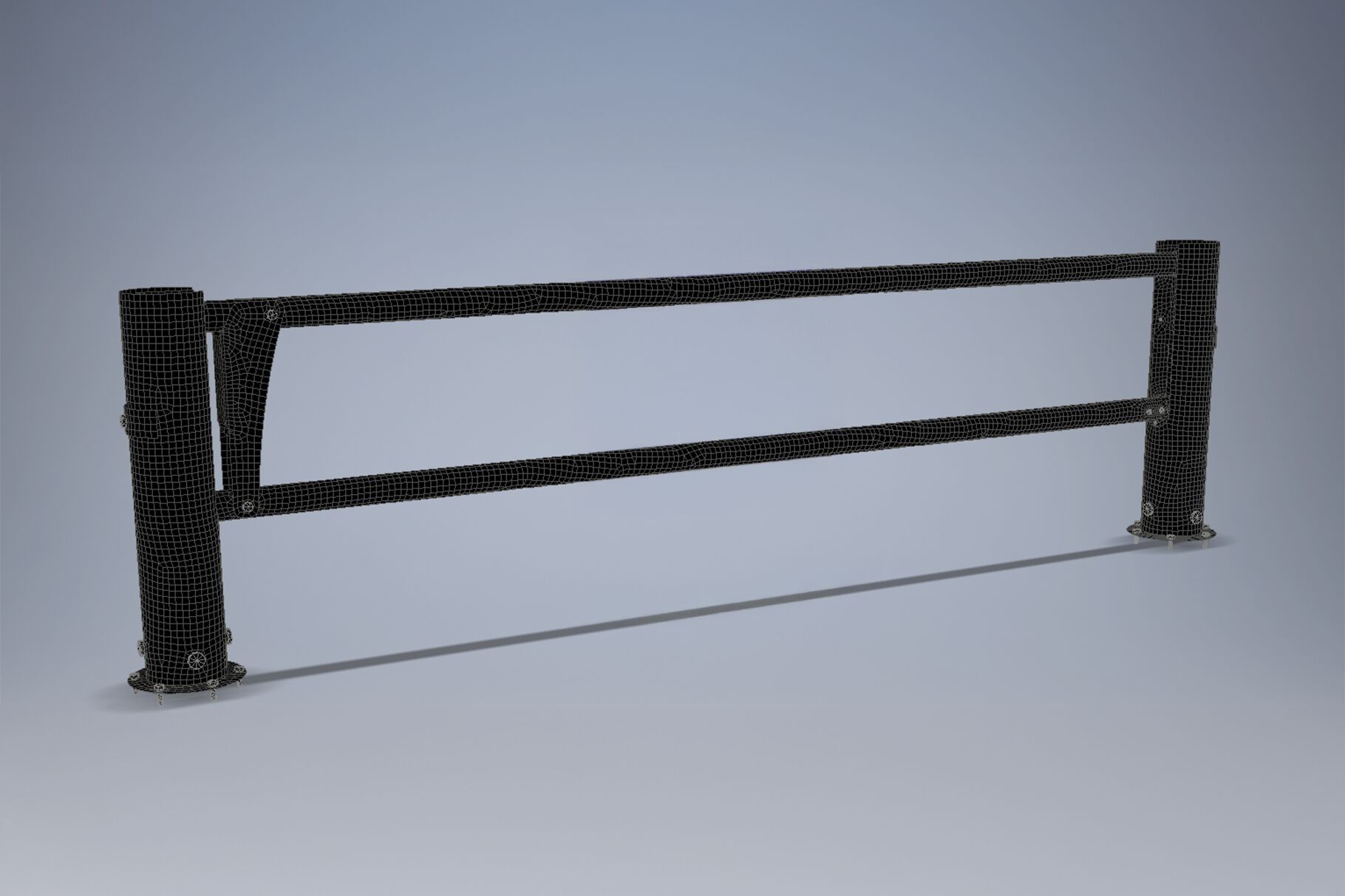
To predict the behaviour of our safety solutions with maximum accuracy, we use advanced simulation software based on Finite Element Analysis (FEA). This tool allows us to assess how a product reacts in various scenarios—such as collision impact at different speeds, angles, and vehicle masses.
FEA works by dividing a digital model into thousands of tiny elements. Each element is analysed individually for force, stress, and deformation. This is done using the Finite Element Method (FEM)—a mathematical technique that calculates how the entire structure behaves under load.
While FEM handles the calculations, FEA focuses on interpreting the results:
- Where do the highest stress levels occur?
- Which areas are most heavily loaded?
- How does the system perform as a whole?
The insights gained from these analyses are invaluable. They allow us to fine-tune our designs and optimise every component for its intended function. FEA also enables us to test and compare multiple design variants virtually—without the time and cost of building physical prototypes.
Simulations as a driver of innovation
Simulations are the backbone of our innovation strategy. We combine data from multiple sources to continuously improve our products.
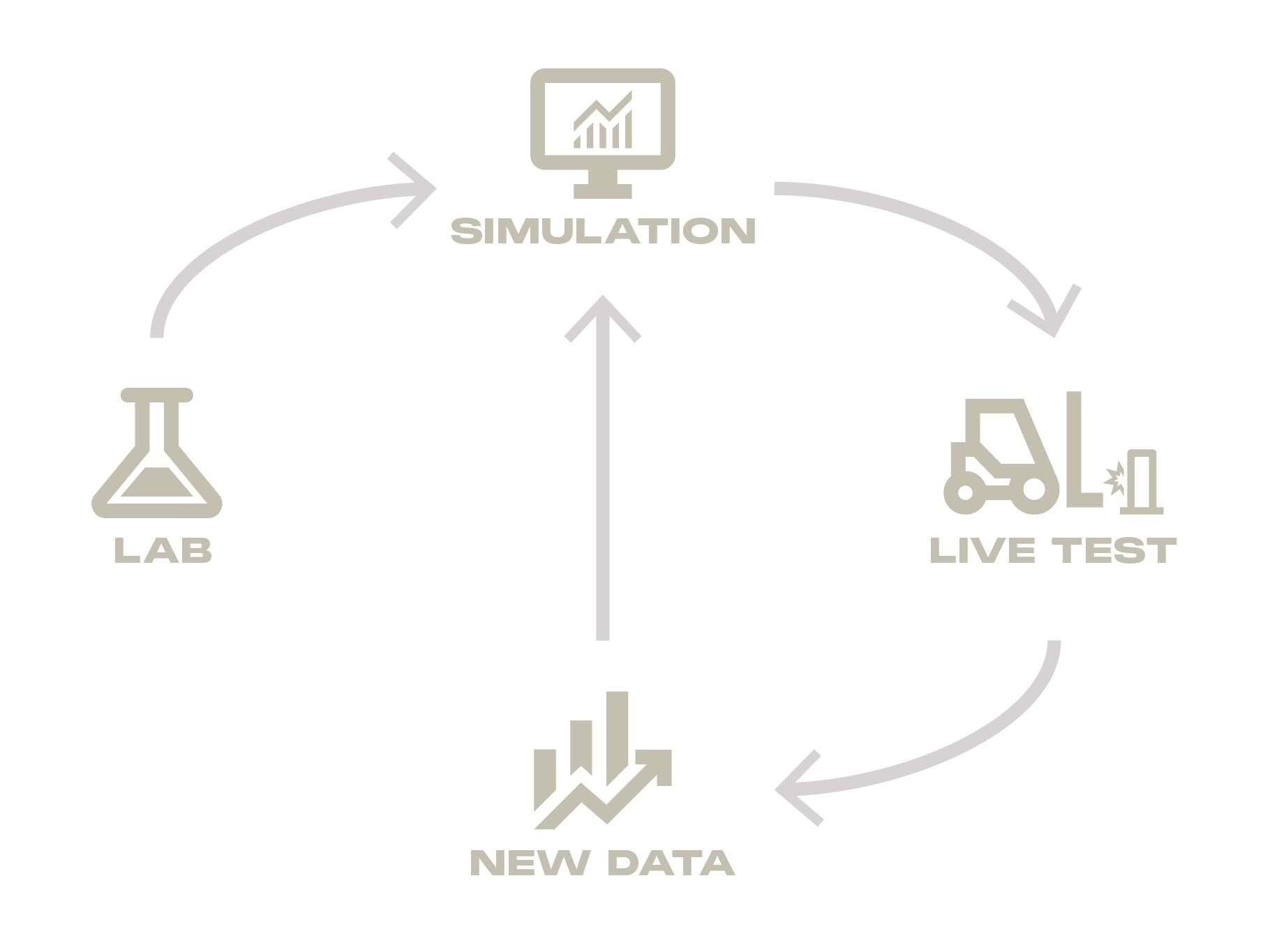
It all starts in our lab, where we develop and test polymers. These lab tests provide crucial data on material properties—such as strength, elasticity, and energy absorption— which we feed into our simulation software. The simulations then generate new insights into stress distribution, deformation, and impact behaviour.
In a final step, we conduct a physical crash test to benchmark and validate the simulation results. If the outcomes align, they confirm the accuracy of our virtual models. We then use this real-world data to further refine the simulations.
This creates a continuous data loop, which fuels faster learning cycles, deeper insights and more intelligent product design. This approach enables us to innovate faster, reduce material and resource waste, and ensure the performance of the final product with confidence.
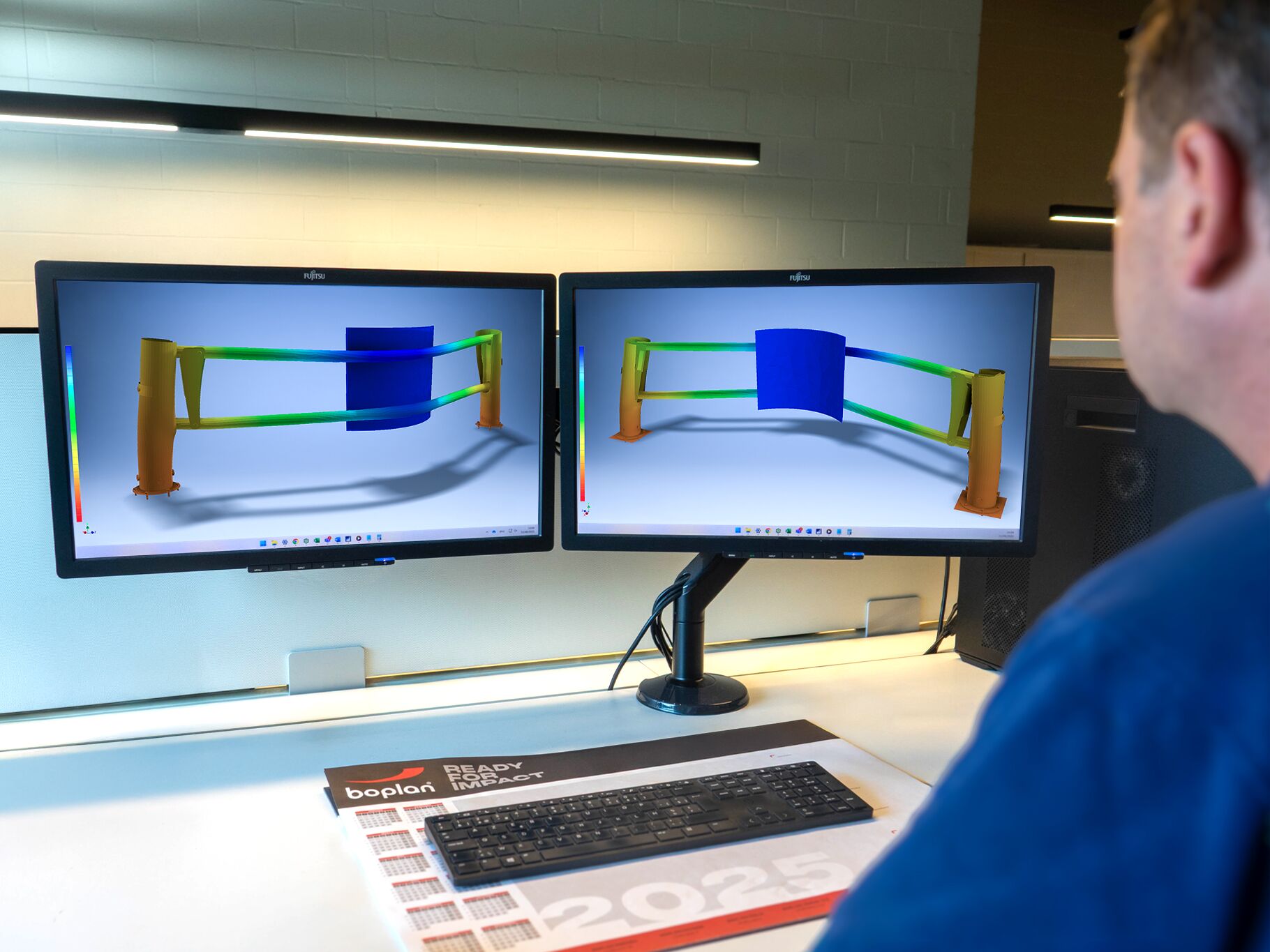

In every simulation, our engineers assess more than just whether a product withstands an impact. They evaluate how it behaves under repeated collisions, how deformation spreads, and which components can be optimised. They think in terms of safety, sustainability, and feasibility—translating raw data into practical insights.
Looking ahead with confidence
The role of simulations in product development is only set to grow. Emerging technologies allow us to analyse increasingly complex scenarios and accelerate improvements. At Boplan, we continue to invest in cutting-edge simulation tools—and in the people who operate them. This enables us to keep delivering safe, reliable and well-engineered safety solutions into the future.