Buyer's guide for column and corner protection
Column and corner protection solutions prevent damage to columns, walls, corners and vulnerable infrastructure in industrial working environments. In warehouses, production halls, distribution centres, car parks and cold storage facilities, forklifts, reach trucks and pallet trucks often operate in close proximity to fixed obstacles. A single wrong move while driving can cause damage or downtime or compromise safety in a matter of seconds.
If you are considering investing in column or corner protection, it is important to look beyond the product itself. The right solution for your site depends on multiple factors: the type of column or corner, traffic in an area, the expected impact levels, amounts of available space and the environment in which a protection solution will be installed.
Find out how to choose the right column and corner protection in this guide.
Table of Contents
This is a practical guide on buying protection solutions for columns, pillars, walls and corners in industrial environments.
What is column and corner protection and what exactly does it protect?
An overview of at-risk infrastructure and the difference between column protection and corner protection.
Risk analysis: What happens if there is no protection?
What are the direct and indirect consequences of a collision with a column, pillar or corner?
Six criteria for choosing the right column and corner protection
The essentials for making an informed choice: object type, traffic, impact, environment, fit and maintenance.
Which Boplan solution is right for which situation?
A practical comparison of Boplan’s KP PROTECTOR, CP UNIVERSAL, SOFT COLUMN COVER and CP CORNER PROTECTOR solutions.
Installation and implementation
What should you consider in terms of assembly, planning, mounting surface, accessibility and phased roll-out?
Dealing with damage, defects and inspections
How do you assess a protection solution following an impact and how can you minimise downtime?
Budget and total cost of ownership
Why the purchase price is only one part of the total investment.
Standards, impact values and technical documentation
What is the correct way to interpret impact resistance, product documentation and certifications?
Combining column and corner protection with other safety solutions
Column and corner protection in practice: Customer testimonials
Column and corner protection FAQs
Tailored advice
Are you considering investing in column or corner protection? If so, you need to know three things: the risks specific to your working environment, the type and density of traffic and the desired level of protection. An area characterised by intensive forklift use requires a different solution from a passageway reserved primarily for pallet trucks or pedestrians.
Keen to find out which solution is right for your columns, pillars, walls or corners? The Boplan team works with you to analyse risk areas and identify the right impact protection solution.
What is column and corner protection and what exactly does it protect?
Column and corner protection covers all solutions that are designed to protect fixed infrastructure against collisions, impacts and abrasion. The focus is primarily on the protection of columns, pillars, H-beams, masts, wall corners, wall ends, partitions and vulnerable edges.
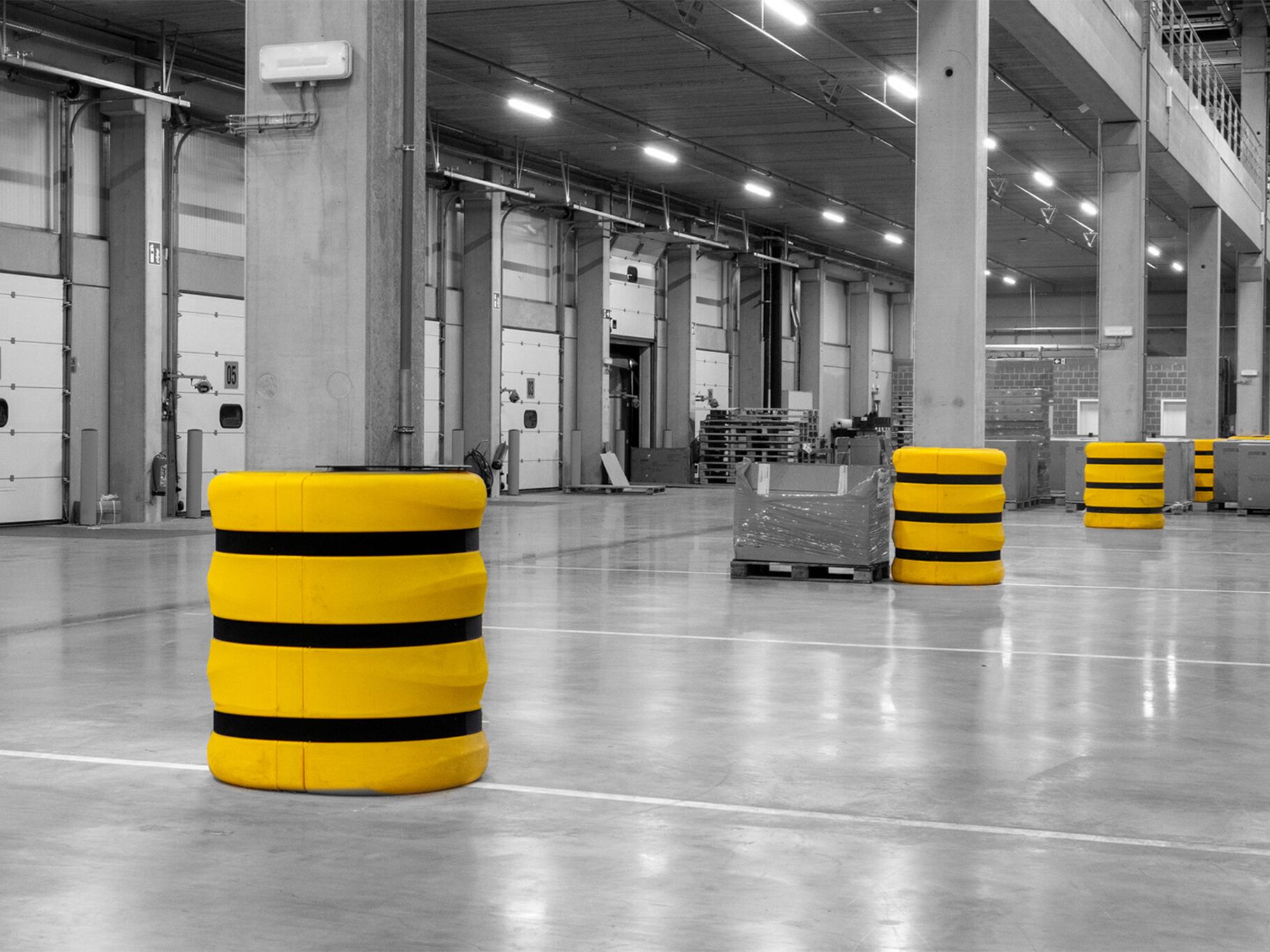
- Column protection is designed for use with freestanding or load-bearing structures. Examples include concrete columns in warehouse aisles, metal support pillars in production halls and H-beams in areas where internal transport vehicles are manoeuvring. When a suitable protection solution is installed around a column, for example, it absorbs the force of a collision before it reaches the structure.
- Corner protection serves a more specific purpose. These solutions are designed to protect the ends and corners of walls, small columns and machine corners from light impacts, abrasion and damage inflicted by pallet trucks or other forms of small mobile equipment. Corner protection can be of particular benefit in environments where drivers have to make tight turns or where goods are transported in close proximity to walls.
The goal is always the same: to prevent damage, make obstacles more visible and improve safety in the working environment.
What happens when no column or corner protection is in place?
Risk analysis
In an operational environment with high internal traffic, it is difficult to safeguard against collisions entirely. A forklift truck may turn too early, a pallet truck may clip the end of a wall or a hand truck may scrape against the corner of a wall. While often minor in scope, the consequences of such incidents can still be significant.
Six criteria for choosing the right column and corner protection
4. Does the protection solution offer the right fit for the column or corner?
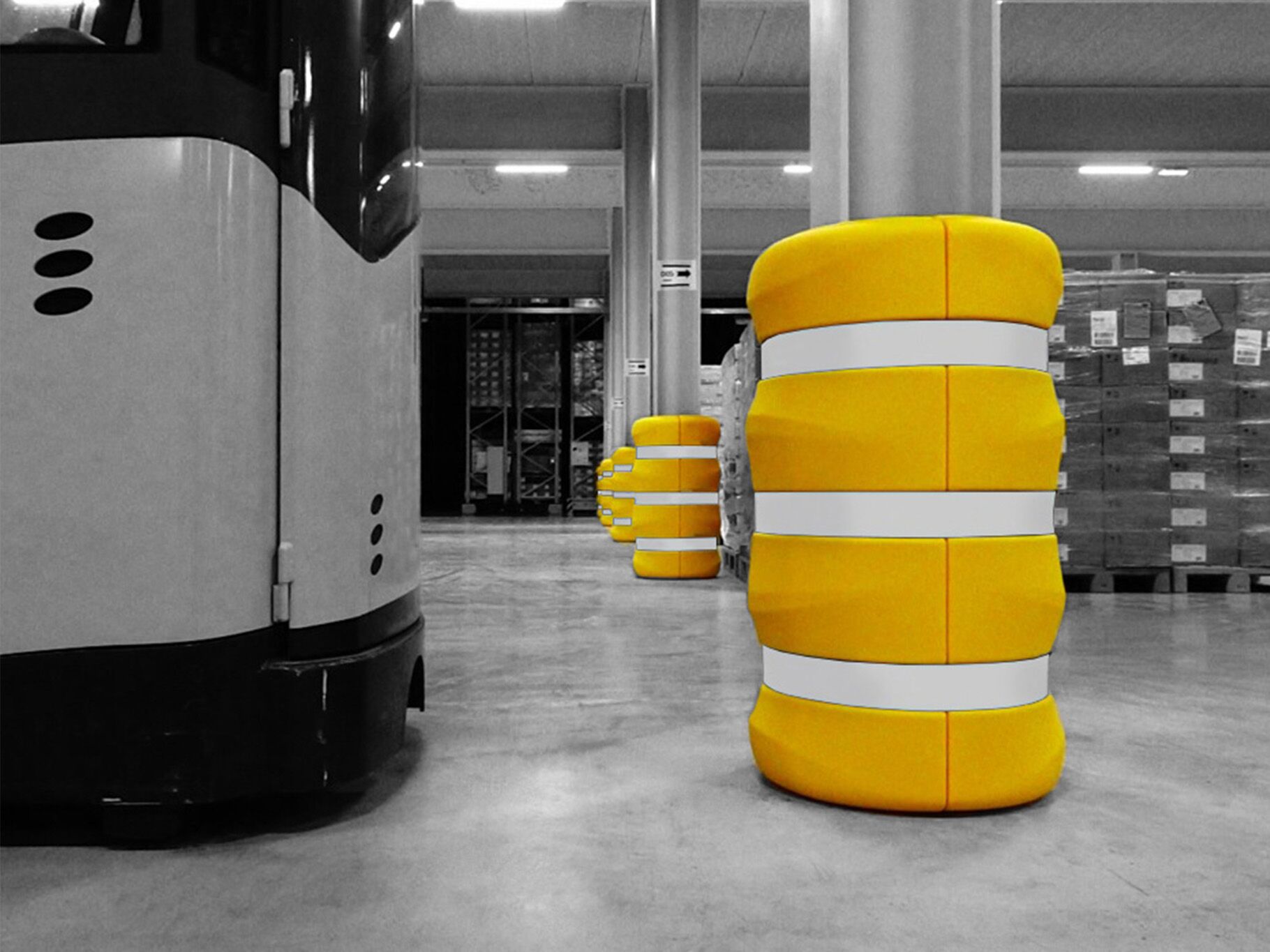
Column and corner protection is only effective when the fit is correct. Protection that is not securely fitted may shift during use. If a solution is too large, it can reduce the width of a passageway. By contrast, a solution that is too small may not provide sufficient protection.
This is why it is recommended to always measure the shape and dimensions of the column, pillar or corner in question. Also check the available space around the object. Some passageways are so narrow that every inch can count towards safety and traffic flow.
5. In which environment will the protection solution be installed?
Not all working environments have the same requirements. In outdoor areas, protection should be resistant to weathering and UV radiation. In refrigerated or freezer environments, the material must remain flexible at low temperatures. In manufacturing or chemical environments, moisture, cleaning procedures and exposure to certain substances all need to be taken into account.
Plastic column and corner protection solutions offer key advantages in this regard. They will not rust, do not need to be painted and ensure excellent visibility. For specialised environments such as industrial cold storage facilities, it is important to choose the right product variant.
In short: When selecting the solution for your environment, don’t focus on impact alone. Also factor in temperatures, indoor or outdoor use, cleaning procedures, chemical resistance and maintenance.
6. How easy is it to install, inspect and maintain such protection solutions?
A good safety solution should not only be strong, but also practical. Simple installation reduces downtime. Easily accessible fasteners speed up inspections. Modular solutions are designed so that only damaged parts need to be replaced.
When installing a column protection solution, ensuring a proper fit around existing columns is particularly important. For corner protectors, the mounting surface is the more important consideration It is therefore advisable to check in advance whether hook-and-loop fasteners, screws or concrete screws should be used for installation.
Have one eye on the future, too. When the layout of your warehouse or production area changes, it is useful to be able to adapt or build on your existing protection measures, or else combine them with other safety solutions.
By weighing these criteria carefully, you can make an informed choice and invest in column and corner protection solutions that meet your safety needs while staying within budget. Ask for expert advice to make your decision even easier.
Which Boplan solution is right for which situation?
Not every column, pillar or corner requires the same type of protection. The right solution depends on the shape of the structure, the available space, the specific traffic in the area and the types of impact you wish to guard against. Boplan offers a wide range of solutions to address these different requirements.
CP UNIVERSAL
For large or irregularly shaped concrete pillars
CP UNIVERSAL is designed for use with large square or rectangular columns. The modular, lattice-like structure makes the solution suitable for columns of various sizes. This type of column protection is therefore ideal for production halls, warehouses and distribution centres where columns don’t all have the same shape and size.
With a height of 1100 mm and an impact resistance of 2.2 kJ, CP UNIVERSAL is suitable for areas with heavier traffic. The solution is erected around the pillar, thus serving as a clear visual marker while providing adequate physical protection.
CP UNIVERSAL is recommended if your goal is to protect large concrete columns.
CP CORNER PROTECTOR
For wall and column corners
CP CORNER PROTECTOR is a compact corner protector for walls, partitions, small pillars and corners of machines. This solution protects vulnerable corners from impacts, abrasion and minor contact.
This type of corner protection is particularly suited for use in passageways, loading bays, warehouse environments and areas where pallet trucks or small carts manoeuvre in close proximity to walls. The yellow plastic design makes the corner more visible while helping to minimise damage caused by repeated contact.
It is important to note that CP CORNER PROTECTOR is not intended to be deployed as a heavy-duty protection against impacts by forklifts. This solution should be used to guard wall corners and ends against minor contact, not as a primary method of protection for load-bearing columns in areas with heavy vehicle traffic.
When preparing to install protection, keep four points in mind:
- Mounting surface and fastening system
Check to make sure the floor, wall or column is suitable for the preferred installation method. - Free passage
Ensure the protection solution does not create new bottlenecks or obstacles. - Visibility
Position the protection solution in a way that allows drivers too see the hazardous object in good time. - Future expansion plans
Where appropriate, opt for solutions that can be combined with barriers, bollards or pedestrian protection later on.
Proper installation not only increases the effectiveness of the protection, but also prevents unnecessary downtime and duplicate work.
Dealing with damage, defects and inspections
While column and corner protection is designed to absorb impacts, it is still important to perform periodic inspections. After a collision, it is recommended to verify immediately that the protection solution is still in good working condition and that there is no damage to the underlying column, pillar or wall.
During inspections, make note of the following:
- Parts that have moved or come loose
- Damaged fixation/fasteners
- Cracks, fractures or deformations
- Damage to the underlying column or wall
- Sharp edges or loose elements
If the impact protection has shifted or become damaged, cordon off the area temporarily if indicated. Check whether the incident was a one-off collision or an indication of a recurring problem with traffic in the area. Repeated damage at the same location is often an indicator that a passageway is too narrow, a route is unclear, the speed limit is too high or visibility is insufficient.
Modular polymer systems have the advantage that components can be meticulously inspected and replaced as required. As a result, repairs are often less extensive than is the case for systems that have to be completely replaced following an impact.
What is the budget, and what are the long-term costs of corner and column protection?
The price of column and corner protection depends on several factors: The type of solution, the dimensions, the number of items requiring protection, the impact resistance, the installation method, the working environment and the complexity of the project.
However, the purchase price should never be the only factor that determines whether or not to purchase a particular solution. An inexpensive solution that fails to offer sufficient protection will be more expensive in the long run due to the frequency of repairs, downtime and recurring damage. By contrast, there is no need to invest in a (very) robust solution if the risk is limited to minor contact caused by pallet trucks.
Budget: look beyond the purchase price alone
Plastic protection solutions frequently deliver long-term benefits. They do not rust, require little maintenance and absorb impacts without fully transferring the resulting force to the underlying structure. As a result, investing in a quality product can prove to be more cost-effective in the long term when compared to repairing infrastructure or vehicles over and over again. In other words, a cost-effective choice starts not by asking, “What does a single protector cost?”, but with the question, “What damage and downtime do I want to avoid?”
Read our blog to learn more about the advantages of plastic safety solutions compared with steel or concrete alternatives.
Standards, impact values and technical documentation
What should you look out for?
Impact values help with an objective assessment of column and corner protection, as they show how much energy a given solution can absorb. However, they must always be viewed in the relevant context. The vehicle weight, speed, impact angle and impact height all determine which type of protection is required.
For high-risk or critical areas, the required impact rating should be determined based on actual operating conditions. Boplan is on hand to provide the tools and expertise needed to accurately assess the risk in each area.
A high-quality solution should provide the following information:
- The intended application
- Its impact resistance
- The working environment in which it can be used
- The material it is made of
- How it should be installed
- The key maintenance or inspection points.
Certifications and standards are only meaningful if it can be demonstrated that they apply to the specific product or configuration. For column and corner protection, the emphasis is on ensuring the impact values are documented correctly, the materials are suitable and the application addresses the actual risk.
Conclusion: Safety as a smart investment
Choosing the right column and corner protection starts with understanding the risks in your working environment. Not every column, pillar or wall corner requires the same solution. A heavy concrete pillar in an area where forklifts are in operation requires different protection than for a sharp metal edge or the end of a wall being scraped by passing pallet trucks.
By considering factors such as traffic, impact, fit, working environment, installation and total cost of ownership, you can make safe, sustainable and ultimately cost-efficient choices.

Purchasing column protection is an investment in operational continuity, safety and a reduced risk of damage. By asking the right questions in advance, you can find a solution that addresses the actual risks at your work site.
Would you like to receive professional advice on which column and corner protection is best suited to your working environment? Contact our team.
Column and corner protection do not stand alone
Combine with other safety solutions
Columns, walls and corners are usually part of a wider traffic flow. This means driving routes, loading bays, racks, machinery, gates, pedestrian areas and passageways. This is why it is often recommended to combine column and corner protection with other safety solutions:
- Safety barriers that mark traffic routes, production lines and machinery.
- Safety bollards installed at gates, passages, installations and vulnerable corners.
- Handrails and safety gates to ensure physical separation between pedestrians and internal transport vehicles.
- Racking protection for pallet racks and end racks.
- Kick rails and wheel stops to minimise damage at ground level.
- Height restrictors for gates, sprinkler lines or areas with limited clearance.
- Floor marking tape and signage to visually support traffic flows.
Combining systems ensures that protection solutions are not functioning in isolation. The use of a consistent safety approach provides better all-round protection for people, vehicles, infrastructure and goods.
Be sure to take a look at our buyer’s guides for industrial safety barriers, bollards, racking protection and safety gates.
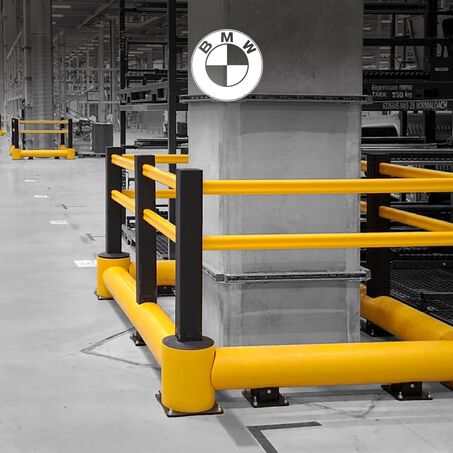
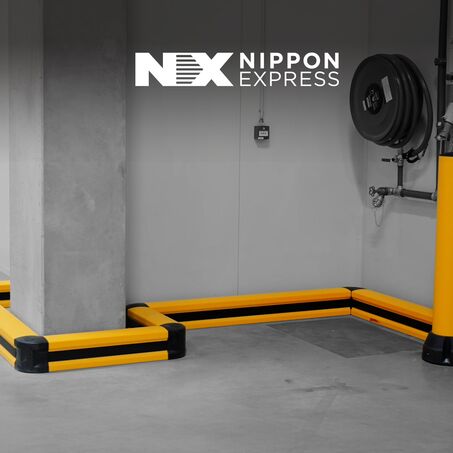
Column and corner protection in practice: Customer testimonials
FAQs about column and corner protection
Column protection is designed to protect pillars, columns, masts and H-beams against collisions. Corner protection is deployed to protect wall corners, wall ends, partitions and smaller vulnerable points from knocks, abrasion and minor impacts.
KP PROTECTOR is usually the most suitable solution for the protection of round columns, H-beams, posts and towers. The protection solution wraps around the column and is designed to absorb impacts before reaching the structure.
CP UNIVERSAL is suitable for large square or rectangular concrete columns. The modular design makes this solution flexible when seeking to protect columns of different sizes.
SOFT COLUMN COVER is primarily intended for minor impacts, contact with small rolling equipment and covering sharp metal edges. For more severe collision risks, it is better to opt for a more robust column protection solution such as KP PROTECTOR or CP UNIVERSAL.
CP CORNER PROTECTOR is suitable for wall corners, wall ends and protection against minor contact caused by vehicles manoeuvring. Do not use this solution as the primary means of protecting load-bearing structures against major impacts by forklifts.
Various solutions are designed for outdoor use. However, make sure to check that the material and configuration are suited to the UV exposure, moisture, temperatures and cleaning requirements.
In refrigerated or freezer environments, the material should remain flexible at low temperatures. With this in mind, always opt for a configuration that is expressly intended for use in such temperatures.
Conduct periodic visual inspections and always check the protection solution following a collision or impact. Check for signs of movement, damaged fasteners, cracks, loose components and damage to the underlying structure.
The price depends on the type of product, the dimensions, the number of protection points, the impact level, the installation method, the working environment and any necessary professional installation services. In other words: always compare the total cost, not just the purchase price alone.
Yes. This is actually recommended in many industrial environments. Column and corner protection can be combined with safety barriers, bollards, handrails, racking protection, safety gates and floor marking tape.
Advice and next steps
Column and corner protection helps to prevent damage to infrastructure, improve workplace safety and reduce maintenance costs. The right choice of protection depends on the types of traffic, column and corner design, expected impact levels and overall site conditions.
Would you like to receive professional advice on which solution is best suited to your warehouse, production hall or logistics site? If so, get in touch with Boplan’s team of safety experts. They will work with you to analyse risk zones, calculate impact values and find a solution that is suitable for your working environment.
Have your work site assessed and discover which column or corner protection solution is right for your requirements.
Get advice from our experts
Compare products, applications and technical features.
Download our catalogue