Buyer’s guide to racking protection
When you invest in racking protection, you want certainty above all: protection for your warehouse racking, a safe working environment for your employees, and a reliable solution that remains cost-effective in the long term. Racking protection is an essential part of a safe warehouse or production environment. It prevents collisions with forklifts or pallet trucks from immediately causing structural damage, downtime or risks to the stability of your pallet racking.
This guide sets out the most common risks, how to choose the right racking protection, which factors determine the total cost of ownership, and how to ensure correct installation and follow-up. Here you’ll find everything you need to make an informed choice about racking protection and safety barriers for pallet racking.
Discover our catalogue Get in touch
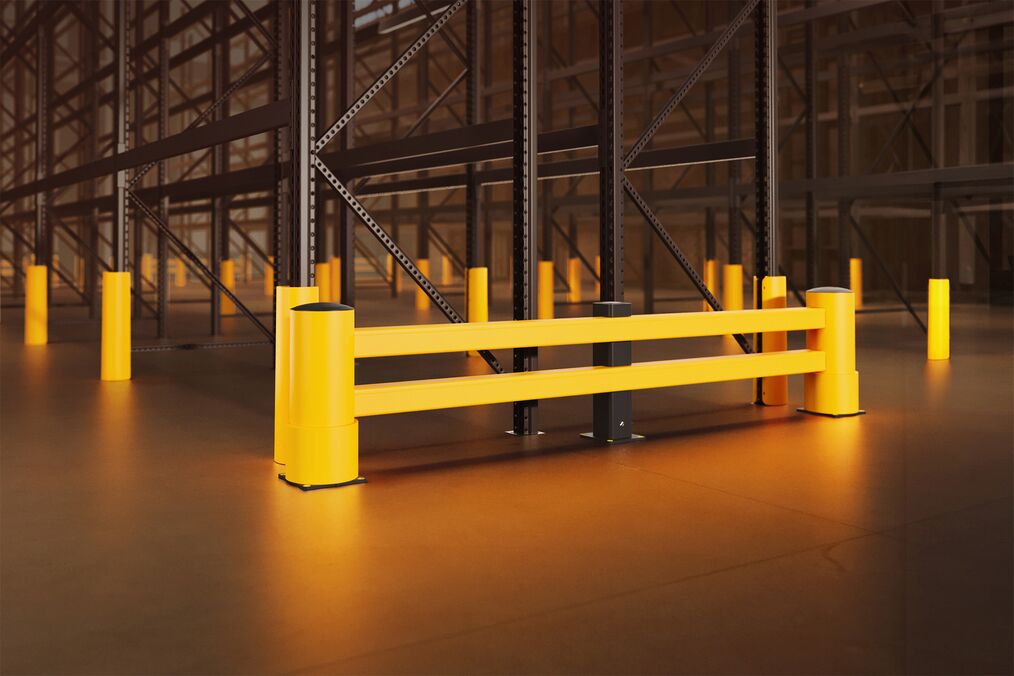
Table of contents
A practical buyer’s guide to protecting warehouse racking safely and sustainably.
What is racking protection and what exactly do you protect?
An overview of the different types of racking protection and how they help prevent damage to rack uprights, end frames and infrastructure. You’ll quickly learn which risks you can keep under control with racking protection.
Risk analysis: what happens without racking protection?
What are the consequences of a collision with a rack upright or end frame? This chapter shows the direct and indirect impact on safety, stability, goods and business continuity.
Selection criteria for racking protection
An analysis of the factors that determine which racking protection is right for your environment. You’ll discover how traffic, impact energy, layout and environmental conditions influence your choice.
Installation and implementation
How do you ensure an efficient and safe installation, both for retrofits and in new warehouses? This chapter covers planning, ergonomics, downtime and a phased approach for optimal rollout.
Dealing with damage, defects and inspections
Learn how to assess damage correctly, what an appropriate inspection frequency is, and how modular systems help you carry out repairs quickly and cost-effectively.
Budget and total cost of ownership
Why is the purchase price only part of the story? Here you’ll learn how racking protection affects the total cost of damage, downtime and replacements, and why TCO should guide your decision.
Standards, certifications and guidelines
This chapter explains how racking protection aligns with pallet racking safety guidelines, and which documents, test results and certifications you can expect from a high-quality solution.
Combining racking protection with other safety solutions
Racking protection in practice: Customer stories
Frequently asked questions about racking protection
Racking protection includes all solutions designed to protect pallet racking against collisions. This includes protection for individual rack uprights, end-of-aisle protection for racking, and additional systems such as bollards and barriers that protect your racking from impacts.
The goal is always the same: to prevent a collision from causing structural damage to the racking, and therefore also to the goods you store or the employees working nearby. In a warehouse where forklifts, reach trucks, pallet trucks or AGVs cross paths, there is an ongoing risk of both minor and major manoeuvres going wrong. That is exactly the reality that racking protection needs to withstand.
By purchasing racking protection and positioning it strategically around uprights and at the ends of racking, you significantly reduce the risk of structural damage. You also immediately reduce the risk of your racking becoming unstable. In the event of heavier impacts, this can sometimes lead to an entire section tipping over or collapsing. The wide range of racking protection solutions covers everything from light-duty guidance systems to robust, impact-absorbing structures with high impact ratings.
Risk analysis: what happens without racking protection?
In a high-traffic operational environment, a collision is often not a question of if it will happen, but when and with what consequences. Forklift trucks that turn in just a fraction too early, pallets that are pulled out too low, or manoeuvres in busy areas can quickly cause damage to uprights and rack feet.
A slight bend may seem harmless, but it does affect the load-bearing capacity of the racking. This is especially the case if the upright has already been subjected to loads in the past – something that can often be identified during a safety or risk assessment.
Repeated impacts weaken the racking and, in extreme cases, can even lead to progressive collapse. This poses a risk not only to the goods you store, but above all to employees and drivers in the immediate area.
Indirect costs also mount quickly. When an upright is damaged, the area often has to be temporarily cordoned off and work in the aisle may come to a halt. Inspections are required, repairs must be scheduled and damaged goods need to be replaced. The total cost of this type of incident can easily exceed the entire investment in well-designed racking protection. Do you want to guarantee safety? Then purchasing racking protection is a must!
1. Type and intensity of traffic
The nature of your traffic determines the level of protection you need. In an area where light pallet trucks operate, you’ll need a different solution than in a main aisle where forklifts move full loads. These traffic flows are part of the critical risk zones in a warehouse. The combination of vehicle type, load weight, speed and manoeuvres gives an indication of the impact energy that racking protection must be able to withstand.
The heavier the traffic, the more important it is to choose racking protection that is proven to absorb impact energy without damaging the racking structure.
2. Impact resistance and energy absorption
The quality of racking protection depends on how the system handles an impact. It’s not just about how strong a structure is; above all, it is about how it dissipates and absorbs energy. Plastic systems with controlled deformation have the advantage of springing back after a collision, without transferring the force directly to the racking.
Before you purchase racking protection, check the tested impact values in kilojoules, test reports from independent bodies, and how the system is designed to absorb energy. For example, an end-of-aisle solution must be able to withstand a much higher horizontal impact than an upright protection unit in the middle of a row.
3. Compatibility with your racking and layout
A standard upright does not require the same racking protection as a wide, perforated upright in a high-bay warehouse. That’s why compatibility is crucial: the upright’s shape and dimensions, aisle width, the layout of crossings and the position of base plates all determine which racking protection you should purchase.
A click-on upright protector only works well when it fits snugly around the profile. End-of-aisle protection must be installed across the full width, in a way that follows the typical turning radius of forklifts. Accurate measurement or professional advice will ensure you install racking protection that performs optimally.
4. Environmental conditions
Not all racking protection performs the same at low temperatures, under chemical exposure or in outdoor areas. In a deep-freeze environment, a system must remain flexible down to -30 °C and must not crack. In the (petro)chemical sector, chemical resistance plays a major role. Plus, if you install racking protection outdoors, you’ll benefit from solutions that are UV-resistant and corrosion-free.
Plastic racking protection often offers advantages here because it does not rust and remains stable under temperature fluctuations, provided it is designed for that environment.
5. Installation, maintenance and modularity
Choosing racking protection becomes easier when the system is easy to install and maintain. Click-and-clamp systems – such as those provided by Boplan – are highly efficient, especially if you need to protect a large number of uprights. Rack end systems typically require floor anchors, which calls for a more careful installation process.
Modularity is a major advantage: if a component needs to be replaced after a heavy impact, it saves significant time and cost if you only have to replace one segment rather than the entire system. Also consider the tools available, such as installation kits, which speed up the work and make it more ergonomic. Especially for large-scale projects.
6. Compliance and future-proofing
A rack protector must do what it promises – and that must be demonstrable. This is why it makes sense to choose manufacturers who have their solutions tested by independent bodies, provide test reports, and support the requirements of auditors and insurers.
Impact values, test set-ups and compliance with pallet racking safety guidelines are important benchmarks. A well-documented system makes it easier to purchase, install correctly and remain audit-ready.
Installation and implementation
A successful installation starts with thorough preparation. Most companies begin with a risk analysis by zone, first identifying the critical locations. Think of narrow aisles, intersections where vehicles cross paths, and areas where frequent vehicle movements take place close to the racking. It helps to collect photographs and measurements and to involve the relevant departments, from HSE to warehouse management, in the planning process.
The choice between in-house and external installation depends on the scale of the project and the complexity of the racking configuration. In-house installation works well for click-and-clamp systems, but for large projects or deep-freeze environments, professional installation is often more efficient. The ergonomic aspect in the installation process also deserves attention. Tools such as installation handles speed up the work and reduce physical strain.
Many organisations opt for a phased implementation. By starting in the busiest zones and then equipping the rest of the warehouse, you limit the impact on day-to-day operations. This approach also makes it possible to assess how employees interact with the protection and whether additional measures are needed.
Budget and total cost of ownership
The initial purchase price of a rack protector only tells a small part of the story. Total cost of ownership (TCO) is determined by installation costs, maintenance, installation time, the number of replacements after impacts and, above all, the costs you avoid by preventing damage.
Plastic systems often offer a financial advantage because they absorb energy without becoming permanently deformed. Unlike steel protection, which must be replaced after every heavy impact, flexible solutions return to their original shape. As a result, your system stays intact for longer and there is less need to replace parts. In addition, flexible systems do not damage the floor or the racking, which further reduces indirect costs.
So always ask yourself what a single incident involving damage to racking would cost you. In many cases, that amount is higher than the entire investment in sustainable racking protection.
Read our blog to learn more about the advantages of plastic safety solutions compared with steel or concrete alternatives.
Although racking protection does not have its own universal standard, it is closely aligned with guidelines on pallet racking safety, inspection and structural loading. Audits require a thorough risk analysis. As a buyer or HSE manager, it makes sense to review which certifications and test reports are available.
An independently tested solution with clearly documented impact values helps you meet audit requirements and demonstrate that you have taken measures proportionate to the risk. It also shows that the manufacturer operates transparently and substantiates its solutions with measurable performance.
Racking protection does not stand alone. It works best when integrated into a broader safety barriers strategy. In areas where vehicles and pedestrians cross paths, safety barriers and handrails are logical additions. Protective bollards help protect corners, machinery or access points, while floor marking tape and signage clearly guide traffic flows.
Combining these systems creates a coherent level of protection that goes beyond the racking alone. It makes your site clearer, safer and more resilient to unforeseen manoeuvres.
Also explore our buyer’s guide on industrial safety barriers or our buyer’s guide to protective bollards, and discover safety solutions that combine perfectly with racking protection.
Case: EUTRACO
In EUTRACO’s distribution centres, intensive forklift traffic regularly created risks for rack uprights and end frames. Boplan installed a combination of racking protection and additional safety barriers to reinforce critical zones. Thanks to upright protectors, end-of-aisle solutions and protection systems around infrastructure, EUTRACO was able to drastically reduce structural damage and significantly increase safety in busy aisles.
Case: Sleepworld
Sleepworld struggled with frequent collisions in narrow aisles and busy picking zones in their logistics warehouse. By installing racking protection on uprights and end frames, combined with extra protection for access points and columns, the likelihood of rack deformation and damage was noticeably reduced. Since then, the solution has provided greater stability for the racking and a clearer separation between forklift routes and storage zones.
Case: Trainz
At Trainz’s new site, racking protection was integrated into the warehouse layout from day one. High-traffic areas were fitted with upright protectors and robust end-of-aisle protection, so the ends of racking rows were no longer vulnerable to forklift manoeuvres. By installing this protection from the outset, the organisation prevents damage and improves long-term operational safety.
Frequently asked questions about racking protection
You are legally required to control risks and ensure a safe working environment. In many warehouses, racking protection is a necessary measure to meet that obligation.
The required impact rating depends on the vehicle type, load weight, travel speed and the likelihood of a collision. Our safety experts will be happy to help you translate these parameters into the right racking protection solution.
Yes, most systems are suitable for retrofit installations. With accurate measurements and a clear risk analysis, you can equip existing racking without issues.
Yes, especially with click-and-clamp systems. For larger projects or complex configurations, professional installation is often more efficient.
At least once a year, or more often where traffic is heavy. After each clear impact, it is best to carry out an additional check.
With modular systems, you only replace the damaged component. However, always check that the rack upright itself is intact. Also check the floor fixings.
Upright protection is primarily designed for side impacts. For frontal impacts at the end of a rack row, end-of-aisle systems are recommended.
High-quality plastic systems are designed to absorb impact energy. Strength depends on the quality of the design and the tested impact values. The RACK END has an impact value of 8.5 kJ. That corresponds to a 6-tonne forklift truck and load hitting the protection head-on at a speed of 6 km/h.